Short answer
Before buying a massage chair, ask what the massage chair warranty covers, who handles service, whether labor and in-home repair are included, how delivery and installation work, whether the chair fits your home, and what return or cancellation terms apply. Warranty, service and delivery can affect total ownership risk as much as the chair itself — so get the answers in writing before you pay, not after delivery.
Why warranty, service and delivery matter
A massage chair is high-ticket, large, mechanical and electronic — closer to an appliance than a piece of furniture. You can judge comfort in a few minutes, but you live with the warranty, the service path and the delivery decision for years. When something needs a part, an adjustment or a technician, the difference between a calm fix and a frustrating ordeal usually comes down to paperwork you could have read before you paid.
Coverage terms vary by brand, model, retailer and purchase channel, and delivery a heavy reclining chair into a second-floor room is rarely as simple as it sounds. Price alone does not explain ownership risk: a slightly more expensive chair with clear in-home service and a plain return policy can be far easier to own than a cheaper one with none of that spelled out. Throughout this guide the rule is the same — written terms matter more than verbal reassurance, and “we’ll take care of it” is not a policy until it is in writing.
- Massage chair warranty
- The written terms describing what the seller or manufacturer will repair or replace, for how long, and under what conditions — usually split into separate tiers with different lengths.
- Parts coverage
- Protection for the chair’s components — motors, rollers, air pump, control boards and the remote — typically for a stated number of years.
- Labor coverage
- Protection for a technician’s time to diagnose and complete a repair. It is often shorter than parts coverage and can be the larger bill.
- Manufacturer warranty
- Coverage provided by the brand that built the chair, which may differ from any additional support a retailer offers.
- Total ownership risk
- Everything that could cost you money, time or hassle after the sale — thin or short coverage, a distant service path, self-install repairs, drop-off-only delivery, or restrictive returns.
Quick warranty, service and delivery checklist
Work through this as you shop — it is a thinking tool, not a sign-up. Tick what a seller actually confirms in writing. You are not looking for perfection; you are looking for clear, specific answers before you commit. Nothing is saved to an account or sent anywhere.
Confirm what a seller actually shows you as you read — it’s a thinking tool, not a sign-up. Your ticks are kept on this device only; nothing is sent.
What does a massage chair warranty usually cover?
Warranties vary widely, and the headline figure — for example, “5-year warranty” — rarely tells the whole story. A meaningful warranty separates coverage into distinct parts, and each can have a different length. A single “5-year” line might mean five years on the frame, three on parts, and one on labor and in-home service. Read each tier separately, and ask specifically what happens in years two through five.

Not all warranties are the same
There is no standard massage chair warranty. Coverage, length and exclusions differ by brand, model, retailer and where you buy. Treat any verbal summary as a starting point, then verify the written terms for the exact model and seller before you pay. Do not assume two chairs with the same “5-year” label are protected the same way.
Warranty promise vs warranty clarity
Reassuring phrases are easy to say. The questions beside them are what turn a promise into something you can rely on.
| Reassuring promise | The question that makes it real |
|---|---|
| “Covered for years.” | Covered for how long on parts, labor, frame and electronics — listed separately? |
| “Service is included.” | Who performs the service, where, and how is a claim requested? |
| “Free delivery.” | Which delivery level — curbside drop-off, or in-room white-glove setup? |
| “We’ll take care of you.” | Where is that written in the warranty, delivery and return terms? |
A confident seller is happy to put the specific answer in writing. Vagueness on the basics is itself useful information.
Parts, labor, frame and electronics coverage
These are the coverage areas worth reading line by line. For each one, ask the question, understand why it matters, and confirm the answer in the written warranty — not just on a sales sheet.
| Coverage area | What to ask | Why it matters | Verify in writing |
|---|---|---|---|
| Parts | Which components count as “parts,” and for how many years? | Parts cover the moving and electronic pieces most likely to need replacing. | A parts list with its term, not just a single headline number. |
| Labor | Is a technician’s time covered, and for how long? | Labor is often shorter than parts and can be the larger cost of a repair. | The labor term, and whether any service-call fee ever applies. |
| Frame | What structural elements does “frame” include? | The frame is usually the longest-covered and least-failing element. | What “frame” means here, since the definition differs by brand. |
| Electronics | Are control boards, sensors and the power supply covered? | Electronic faults are common and can be costly to diagnose. | That boards and the remote are named, not assumed. |
| Motors & rollers | Are the massage motors, gears and rollers covered as parts? | These do the actual work and wear with regular use. | That the mechanism is included, with its own term. |
| Upholstery | Is the cover or upholstery covered, and against what? | Upholstery is frequently excluded or covered only briefly. | Any exclusions for normal wear, pets or sunlight. |
| Remote / control panel | Is the remote or control panel covered and replaceable? | A failed remote can disable an otherwise working chair. | Replacement availability and cost after coverage ends. |
Who handles service after purchase?
Even a generous warranty is only as good as the people behind it. The questions that matter most are about logistics, not coverage on paper. Service after a massage chair purchase can run through several different paths, and it helps to know which one applies before you need it.
- Retailer supportThe seller is your first call and coordinates the repair.
- Manufacturer supportThe brand handles claims, parts and authorized repairs.
- Third-party technicianA contracted in-home service company does the work.
Whoever owns the repair, ask how a realistic service request would actually unfold. A confident, specific answer is reassuring; a vague one tells you what to expect later.
Service request process
- Who do I call first — the retailer, the manufacturer or a service line?
- How is a service request made: phone, email or an online portal?
- Is in-home service available, or is the chair or part shipped?
- What proof of purchase or registration do I need to keep?
- Are replacement parts available, and for how long after I buy?
- What is the typical service process from first call to completed repair?
- What support exists after the warranty ends, and at what cost?
Service availability and timelines vary by seller and location, so treat any estimate as a question to confirm rather than a promise. It is reasonable to ask a seller to describe a recent repair: what broke, who fixed it, and how long it took.
In-home service vs ship-back service
How a repair physically happens changes the experience completely. In-home service is the most convenient; ship-back and self-install options can mean weeks without your chair, or lifting a heavy unit back into a box. Terms vary and must be confirmed in writing.
| Service type | What it means | Questions to ask |
|---|---|---|
| In-home service | A technician travels to your home to diagnose and repair the chair. | Is it included or paid? Who is the technician, and how far do they travel? |
| Ship-back service | You return the chair or a component for repair, sometimes at your cost. | Who packs it, who pays freight, and how long are you without the chair? |
| Parts-only support | The seller mails a replacement part for you to fit yourself. | Is self-installation expected? Is guidance provided? What if it is complex? |
| Remote troubleshooting | Phone, video or email help to resolve issues without a visit. | If remote help does not fix it, what is the next step — and who arranges it? |
Many warranties combine these — remote help first, then parts or a visit. Ask which applies in year one versus later years.
Delivery options: threshold, room-of-choice and white-glove
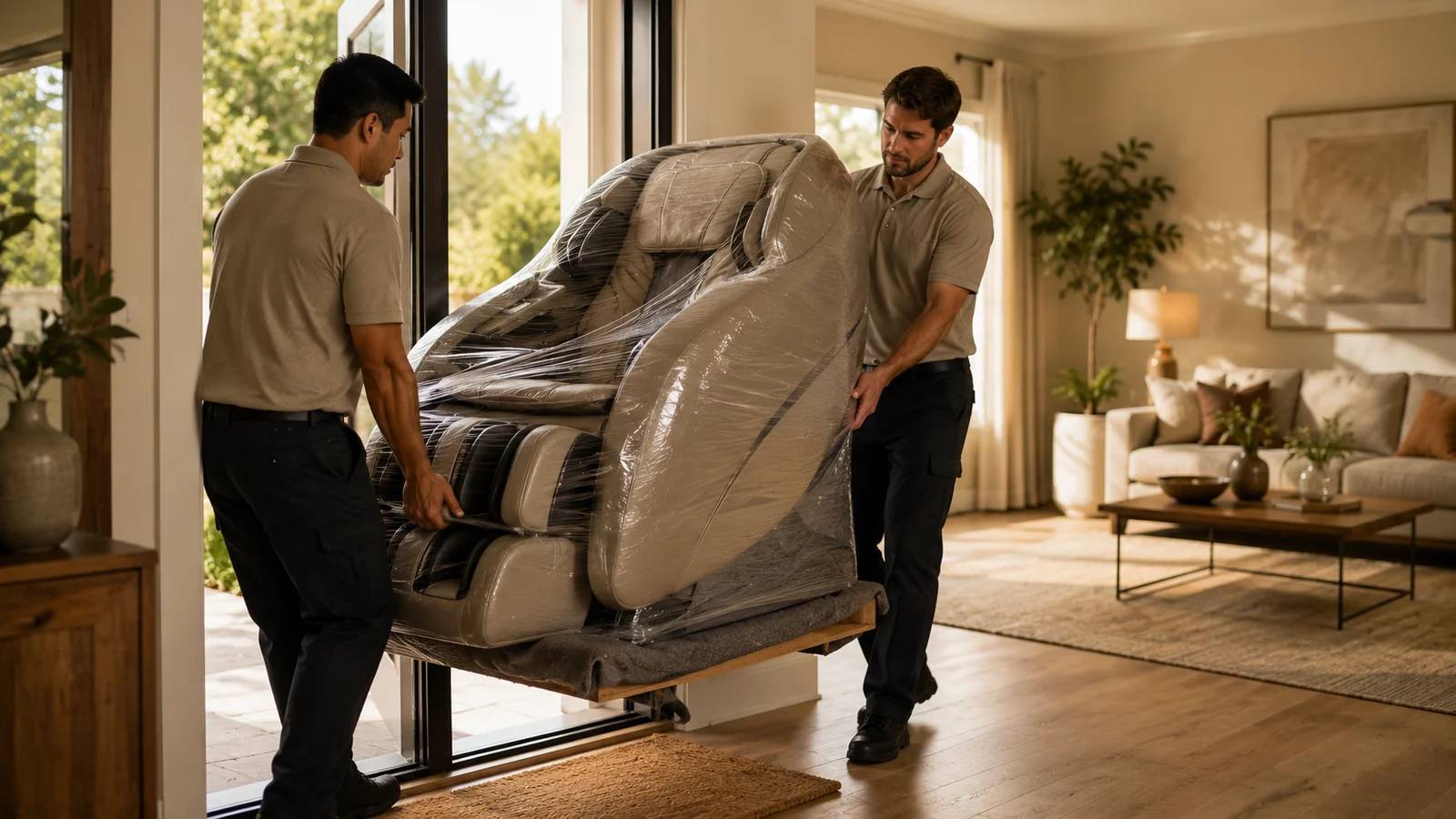
Massage chairs are large and heavy, often well over a hundred pounds in a single box, and many recline against a wall or need their base, arms and back assembled. How the chair reaches your room is a genuine decision, not a detail. “Delivery” can mean anything from a box at the curb to a team that assembles and tests the chair in place — and “free delivery” usually refers to the most basic level.
- Curbside delivery
- The chair is dropped at the curb, driveway or garage. Moving it inside, assembling it and removing packaging are all yours.
- Threshold delivery
- The chair is brought just inside your first doorway or entryway; everything past that point is your responsibility.
- Room-of-choice delivery
- The chair is carried to the room you choose, often including upstairs; assembly may or may not be included, so confirm it.
- White-glove delivery
- A team brings the chair to your room, assembles and positions it, usually powers it on to check it works, and removes the packaging.
- In-home service
- A technician travels to your home to repair the chair later in ownership, rather than you shipping it back.
| Delivery level | What arrives, and where | Assembly & placement | Packaging removal | Typical cost |
|---|---|---|---|---|
| Curbside | Dropped at the curb, driveway or garage | You move, assemble and position it | You dispose of it | Lowest, sometimes included |
| Threshold | Just inside the first doorway | Moving and assembly are yours | Usually left with you | Low |
| Room-of-choice | Carried to the room you choose, often upstairs | Placed in the room; assembly may be separate — ask | Often removed; confirm | Moderate |
| White-glove | Brought to the room of your choice | Assembled, positioned and usually powered on and checked | Removed for you | Highest, or a paid add-on |
Delivery questions to confirm
- What exactly is included at the delivery level I am paying for?
- Are stairs included, and is there a limit on the number of flights?
- Does delivery include assembly of the chair?
- Does it include placing the chair where I want it?
- Are the packaging and debris removed?
- What happens if access is blocked, or the chair will not fit?
Installation and space-fit questions
The most common delivery surprise is the simplest: the chair will not fit. Before you order, measure the whole path — not just the room. A chair that clears the front door can still be stopped by a tight hallway turn, a narrow stairwell or a low ceiling on the landing. Plan for the clearance the chair needs to fully recline, too, since that space is easy to forget.
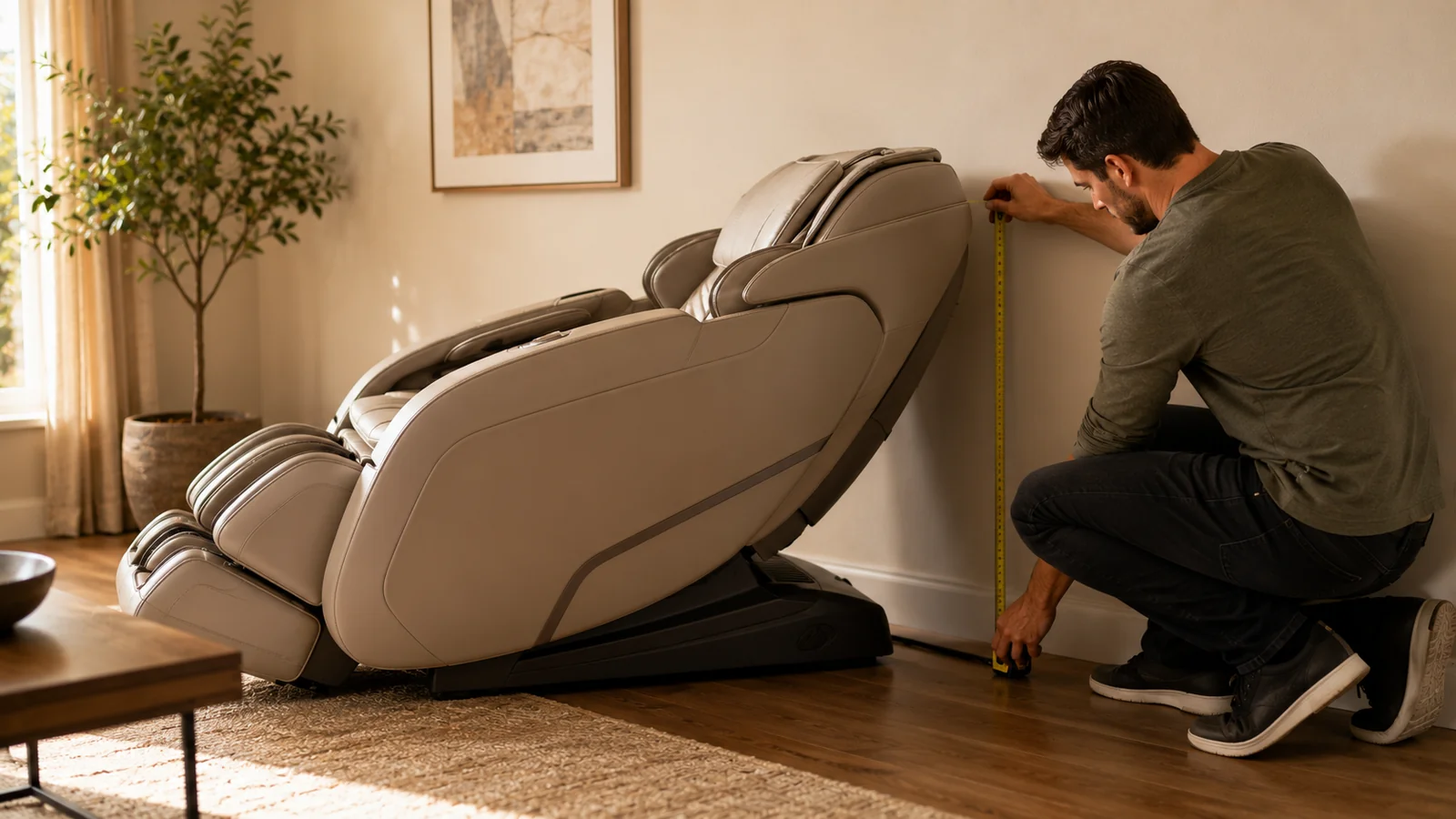
- Doorway width at every door on the path to the room.
- Hallway turns and any tight corners the box must round.
- Stairs or elevator — flights, landings and elevator dimensions.
- Room clearance around the chair’s footprint once it is placed.
- Recline clearance behind and in front of the chair when fully extended.
- Power outlet location relative to where the chair will sit.
- Floor protection for hard floors or to spread the chair’s weight.
- Ability to move it later if you rearrange or relocate the room.
What happens if delivery fails or the chair arrives damaged?
Policies for failed or damaged deliveries are not universal, so the goal here is to know the steps and ask the right questions before they ever come up. If a chair arrives damaged, what you do in the first hour often matters more than the warranty.
- Inspect at delivery. Look over the box and the chair before the team leaves, while you still have help on site.
- Document any damage. Take clear photos of the packaging and the chair, and note damage on the delivery paperwork.
- Understand acceptance vs refusal. Ask in advance whether you should refuse a visibly damaged delivery or accept and report it — the right move depends on the seller’s policy.
- Contact the seller promptly. Report damage to the retailer or manufacturer quickly, since claim windows can be short.
- Ask about the replacement process. Repair, replacement parts or a full swap — and how long each typically takes.
- Confirm who pays return shipping if a damaged chair has to go back.
- Get timeline expectations in writing so a problem does not stall indefinitely.
- Shipping damage
- Damage that occurs in transit or handling, best caught at delivery and documented with photos before the team leaves.
- Return shipping
- Who arranges and pays to send a large, assembled chair back — a real cost worth confirming before you buy, not after a problem.
There is no single industry rule for damaged deliveries, so confirm each seller’s process in writing rather than assuming. “Ask” and “verify” are the safest defaults here.
Return, cancellation and restocking terms
Returning a large, assembled chair is nothing like returning a small product, and assumptions about returns are a common source of disappointment with big-ticket items. Read these terms before you buy, and get the answers in writing.
- Return window: whether returns are accepted at all, and for how many days.
- Restocking fees: whether a percentage is deducted, and how much.
- Return shipping: who arranges and pays freight on a heavy item.
- Cancellation deadline: how late you can cancel before delivery without penalty.
- Special or custom orders: whether made-to-order configurations are returnable at all.
- Open-box and final-sale risk: what condition voids a return, and which items are non-returnable.
- Written confirmation: the full policy in writing, dated, before payment.
Price vs total ownership risk
Two chairs at the same price can carry very different ownership risk. This is a way to think about the trade-off, not a rating of any seller.
| What you compare | Price-first view | Ownership-risk view |
|---|---|---|
| Upfront price | The number on the tag | One input among several |
| Warranty depth | Assumed “good enough” | Read by tier: parts, labor, frame, electronics |
| Service access | Ignored until something breaks | A named, reachable repair path confirmed first |
| Delivery & setup | Treated as free or trivial | Priced and scoped — curbside vs white-glove |
| Returns | Assumed easy | Window, fees and freight confirmed in writing |
A lower price can be perfectly fair — the point is to compare like for like, including the support that comes after delivery.
Online vs showroom: warranty and delivery differences
Neither route is automatically better, and a showroom does not guarantee better terms. What changes is how much you verify yourself versus in person. Both can be excellent when the seller is transparent.
Buying online
- Written policy review is critical — read it before you pay
- Delivery and returns may need more self-verification
- The marketplace seller’s identity matters
- Confirm the service path before purchase, not after
Buying in a showroom
- You can ask warranty and delivery questions directly
- Service and delivery can be clarified in person
- Written confirmation is still needed — ask for it
- A showroom does not automatically mean better terms
Warranty and service by brand or retailer
Warranty and service terms can vary by brand, model, retailer and purchase channel, so the safest approach is to verify them for the exact chair you are considering rather than relying on a brand’s general reputation. Authorized-dealer status may matter, but it is a claim to verify with the manufacturer, not proof of good service on its own.
- Do not assume the same terms apply everywhere a brand is sold.
- Model-specific documentation matters — warranties can differ between models in the same line.
- Ask for the current warranty document for the exact model and seller.
- Confirm who honors the warranty: the brand, the retailer, or both.
You may encounter names such as Osaki, Infinity, Panasonic, OHCO, D.Core, Positive Posture, Koyo, Ogawa or Kyota. We do not rank brands or compare unsupported warranty claims — the point is simply to verify terms model by model, wherever you buy.
Red flags in warranty, service and delivery
None of these is proof of bad intent — treat each as a prompt to slow down and ask more before you commit. A trustworthy seller will welcome the questions.
- Vague warrantyCoverage described loosely, or only verbally, never in writing.
- “We’ll take care of it”Reassurance with no written terms behind it.
- Unclear service contactNo straight answer on who you call or how.
- No in-home service explanationSilence on whether a technician comes to you.
- Unclear delivery methodLevel, scope and stairs left undefined.
- No room-fit guidanceNo help measuring doorways, path or recline clearance.
- Hidden feesDelivery, setup or restocking costs that appear late.
- Unclear return shippingNo answer on who pays to send a chair back.
- Pressure to buy firstUrged to commit before reading the policies.
- Medical claims as distractionHealth promises used to skip over ownership details.
A note on medical-sounding claims
Evaluate a massage chair for comfort, relaxation, body fit and ownership support. Medical-sounding claims should not replace written warranty, service and delivery terms — if a pitch leans on health promises but stays vague on coverage and repairs, that is a reason to ask more, not fewer, questions. For any diagnosed condition, consult a qualified healthcare professional.
This section is general consumer education, not medical advice.
Questions to ask before you buy
Bring these to any showroom visit or seller conversation. Clear, confident answers are a good sign; hesitation on the basics is worth noting. Tick the ones you have a solid, in-writing answer to.
Kept on this device only — no account, no email.
Key takeaways
- Read parts, labor, frame and electronics as separate tiers with separate lengths.
- Confirm who performs repairs, whether it is in-home, and a realistic timeline before you buy.
- White-glove delivery places, assembles and checks the chair in your room; curbside leaves the rest to you.
- Measure the whole path — doorways, turns, stairs and recline clearance — not just the room.
- Get warranty, delivery and return terms in writing; ownership risk is the total cost if something goes wrong after the sale.
How we evaluate ownership support
We are an independent guide, not a retailer — we do not sell massage chairs, rank sellers or brands, or take payment to feature anyone. When we describe what makes after-sale support trustworthy, we look at the same fronts we ask you to: warranty clarity, service access, delivery transparency, installation detail, return and cancellation terms, total ownership cost, and whether all of it is documented in writing. We use no fake guarantees, seals, ratings or awards. Where our standards or methods are relevant, we link to them in the open so you can check our work.
Editorial standards
How we decide what to publish, and the line we hold between guidance and selling.
Disclosure
How we stay independent, and how the site is funded and operated.
Medical disclaimer
Why we treat health and wellness claims cautiously, and where to get medical advice.
Planning to ask these questions in a showroom?
If you are heading to a showroom, take this guide’s questions with you and ask them out loud. The same warranty, service and delivery checks apply wherever you shop — the value of a visit is getting clear, in-person answers you can then confirm in writing. Our regional guides explain what to look for and how to compare before you go. They are guidance, not a directory of specific stores, and not places we operate or endorse.
Should you try before buying?
What an in-person test reveals, and how to test at home.
Plan your try-before-buy visitWhat makes a showroom legitimate?
The trust signals a credible showroom shows before you visit.
See showroom standardsCalifornia showroom guidance
Statewide guidance on comparing showrooms before you go.
California guidanceBay Area showroom guidance
Evaluate Bay Area showrooms with the same neutral checklist.
Bay Area guidanceHow should you verify a retailer's warranty, delivery and service claims?
Read every after-sale promise as a claim to confirm, not a guarantee, and get the specifics for your exact chair in writing before you pay. Some retailers publish their ownership-support details up front — for example, both Massage Chairs & More California showroom information and House of Massage Chairs multi-brand showroom information describe white-glove delivery, in-home setup and manufacturer-warranty coverage on their public pages. Treat those descriptions as a useful starting point, then ask any seller to verify in writing who provides the warranty; the parts, labor, structural-frame and in-home-service terms; whether remote troubleshooting is offered and how quickly a technician is available; the delivery level, and whether stairs, assembly, installation and packaging removal are included; the damage-reporting period and replacement process; and the return-freight, restocking-fee and cancellation terms. Written answers you can keep matter more than any showroom summary.
Note: Massage Chairs & More and House of Massage Chairs are included as public showroom examples to verify, not rankings or endorsements — confirm current warranty, delivery and service terms directly.
Frequently asked questions
What should I ask about a massage chair warranty?
Ask what is covered and for how long, with parts, labor, frame and electronics listed separately, since they often have different terms. Confirm whether in-home service is included, who performs repairs, how a claim is requested, what is excluded, and whether the terms are written for your exact model. Treat any verbal summary as a starting point and verify it in writing before you pay.
What does a massage chair warranty usually cover?
Coverage varies by brand, model and seller, but warranties commonly separate parts, labor, frame and electronics, each with its own length. A “5-year” headline might mean five years on the frame, three on parts, and one on labor. Not all warranties are the same, so read each tier separately and confirm the written terms rather than assuming two chairs are protected equally.
Who services a massage chair after purchase?
Service may run through the retailer, the manufacturer, or a third-party technician, depending on the chair and seller. Some repairs are handled in your home; others involve shipped parts you install yourself, or returning the chair. Ask who you call first, how a request is made, whether in-home service is available, and what the typical process looks like before you need it.
Is in-home service available for massage chairs?
Sometimes, but it is not universal, so confirm it in writing. In-home service means a technician travels to you to diagnose and repair the chair, which is the most convenient option. Other warranties rely on shipped replacement parts you fit yourself, or require sending the chair back. Ask whether in-home service is included or paid, and for how many years it applies.
What is white-glove delivery for a massage chair?
White-glove delivery means a team brings the chair to the room of your choice, assembles and positions it, often powers it on to confirm it works, and removes the packaging. It costs more than curbside drop-off but removes the heavy lifting and assembly. “White-glove” is not defined the same way by every seller, so confirm exactly what is included before you buy.
What delivery questions should I ask?
Ask which delivery level is included — curbside, threshold, room-of-choice or white-glove — and what each covers. Confirm whether stairs are included, whether the team assembles and places the chair, whether packaging is removed, and what happens if access is blocked or the chair will not fit. Measure your doorways, the path to the room, and recline clearance before delivery day.
Will a massage chair fit through my doorway?
It depends on the model and your home, so measure first. Check the width of every doorway on the path, any hallway turns, stairs or elevator dimensions, and the clearance the chair needs to fully recline. A chair that clears the front door can still be stopped by a tight corner or stairwell. Share these measurements with the seller and ask what happens if it does not fit.
What return policy should I check?
Confirm whether returns are accepted, the length of the window, any restocking fee, and who pays return freight on a heavy item. Ask about the cancellation deadline before delivery, whether special or custom orders are returnable, and what condition is required. Large assembled chairs are often restricted, so get the full policy in writing before you buy rather than assuming returns are easy.
What happens if a chair arrives damaged?
Inspect the box and chair before the delivery team leaves, photograph any damage, and note it on the paperwork. Ask in advance whether to refuse a visibly damaged delivery or accept and report it, since policies differ. Contact the seller promptly because claim windows can be short, and confirm the replacement process, who pays return shipping, and the expected timeline in writing.
Should warranty and delivery affect where I buy?
Yes. Warranty clarity, the service path and delivery method shape years of ownership and can affect total ownership risk as much as the chair itself. A clear, written warranty, in-home service and transparent delivery can make a slightly pricier chair easier to own than a cheaper one with none of that spelled out. Compare sellers on ownership confidence, not price alone.
Before you buy
Review warranty, service and delivery questions before you buy
A few clear questions about coverage, repairs and delivery — answered in writing — can save years of avoidable hassle after the sale.
Independent guidance — we don’t sell massage chairs, rank brands or retailers, or take payment to feature anyone.
Last updated: July 2026 · Editorial standards · Disclosure