Short answer
Whether you buy a massage chair online or in a showroom, the safer route depends on your priorities. Buying online is convenient and offers wider selection when pricing, return policy, warranty, delivery, installation and service are clear in writing. Visiting a showroom lowers comfort and body-fit risk, because you can test pressure, recline, foot and calf fit, and the controls in person. Reviews and specs help on both routes but can’t prove personal comfort. Many buyers test in a showroom first, then choose where to buy once they know what fits.
Key takeaways
- Online and showroom are both legitimate routes — the safer one depends on your risk tolerance, budget, body-fit concerns and support expectations, not price alone.
- Online wins on convenience and selection, but you verify comfort and fit through specs, reviews and the return policy instead of your own body.
- A showroom lowers comfort and body-fit risk because you can test pressure, recline and controls in person — though it can’t prove long-term satisfaction or future service.
- Compare warranty, service, delivery and total ownership cost on both routes; a single star rating or a low price shouldn’t decide a multi-year purchase.
Key terms
- Showroom testing
- Sitting in the exact model you’re considering, long enough to judge body fit, pressure, recline and the controls before you commit.
- Comfort risk
- The chance a chair won’t suit your body or pressure preference — the hardest thing to judge from a listing and the easiest to judge in person.
- Return complexity
- How hard it is to send a heavy chair back: the return window, any restocking fee, and who pays return shipping.
- Total ownership cost
- The full cost of owning the chair over time — the purchase price plus delivery, installation, any optional warranty, and service.
- White-glove delivery
- Delivery that brings the chair to the room of your choice, assembles it, and removes the packaging.
- Marketplace seller identity
- Who is actually selling and shipping a marketplace listing — the brand, an authorized dealer, or a third party — and whether the warranty applies through them.
Should you buy a massage chair online or in a showroom?
There’s no single best place to buy a massage chair. The better question is whether the route you choose lets you answer the same handful of practical questions before money changes hands: Does the chair fit your body? How does the return policy actually work? Who handles delivery and setup? What does the warranty cover, and who services the chair? And is the seller describing it honestly, especially around health language? Both routes can answer those questions well — they just make each one easier or harder.
- Online can work when the policies and risks are clear: a written return policy, transparent delivery and warranty terms, and detailed, model-specific reviews.
- A showroom can help when comfort and fit are uncertain, because you can test pressure, recline and controls in person.
- Reviews and specs are useful on both routes but incomplete — they show patterns, not how a chair will feel for you.
- Warranty, service and delivery deserve the same scrutiny whichever door you choose.
- Price alone shouldn’t decide. Weigh it against comfort risk, support and total ownership cost.
The online research path
Browse far more models than any floor holds, compare specs and reviews at your own pace, and verify fit through dimensions and the return policy. A legitimate route when the terms are clear.
When online makes senseThe showroom testing path
Sit in the chair, feel the pressure and recline, compare a few models side by side, and ask questions in real time. A legitimate route when fit and comfort are the open questions.
When a showroom helpsMassage chair showroom vs online: a side-by-side comparison
| Factor | Buying online | Visiting a showroom |
|---|---|---|
| Convenience | Shop anytime, at your own pace, from anywhere | Requires a trip, but hands-on |
| Comfort testing | Inferred from specs, photos and reviews | Tested directly by sitting in the chair |
| Price comparison | Easy to compare many models and sellers | Compare a few floor models in person |
| Warranty clarity | Read the written terms before ordering | Ask, then confirm in writing on the spot |
| Delivery questions | Confirm curbside vs room-of-choice setup | Often arranged locally; still confirm details |
| Return risk | Higher if the policy or fees are unclear | Lower once you’ve felt the chair; still check the policy |
| Pressure risk | No sales pressure, but no in-person test either | Hands-on, but pace yourself against any pressure |
| Service clarity | Verify who supports repairs and how | Ask who services the chair and how |
Our massage chair buying checklist turns these factors into a printable list you can carry into either route.
Where to buy, in one place
Once you’ve decided which route fits, a companion guide gathers the practical side of the decision: the seller types you’ll encounter (brand sites, authorized dealers, marketplaces and local showrooms), the verification questions to ask before you pay, the criteria that separate a credible showroom from a weak one, and a few selected public California showroom examples to show how those criteria look in the real world. It’s written to help you compare sellers fairly on either route, not to push one. Read where to buy a massage chair alongside this comparison.
When buying a massage chair online can make sense
Buying online is genuinely useful. You can browse far more models than any one showroom floor holds, read specifications carefully, compare at your own pace, and often surface detail that a busy sales visit doesn’t. For many people, that breadth and calm are exactly right — especially if you’ve already tested a similar chair and understand the comfort risk of buying one unseen.
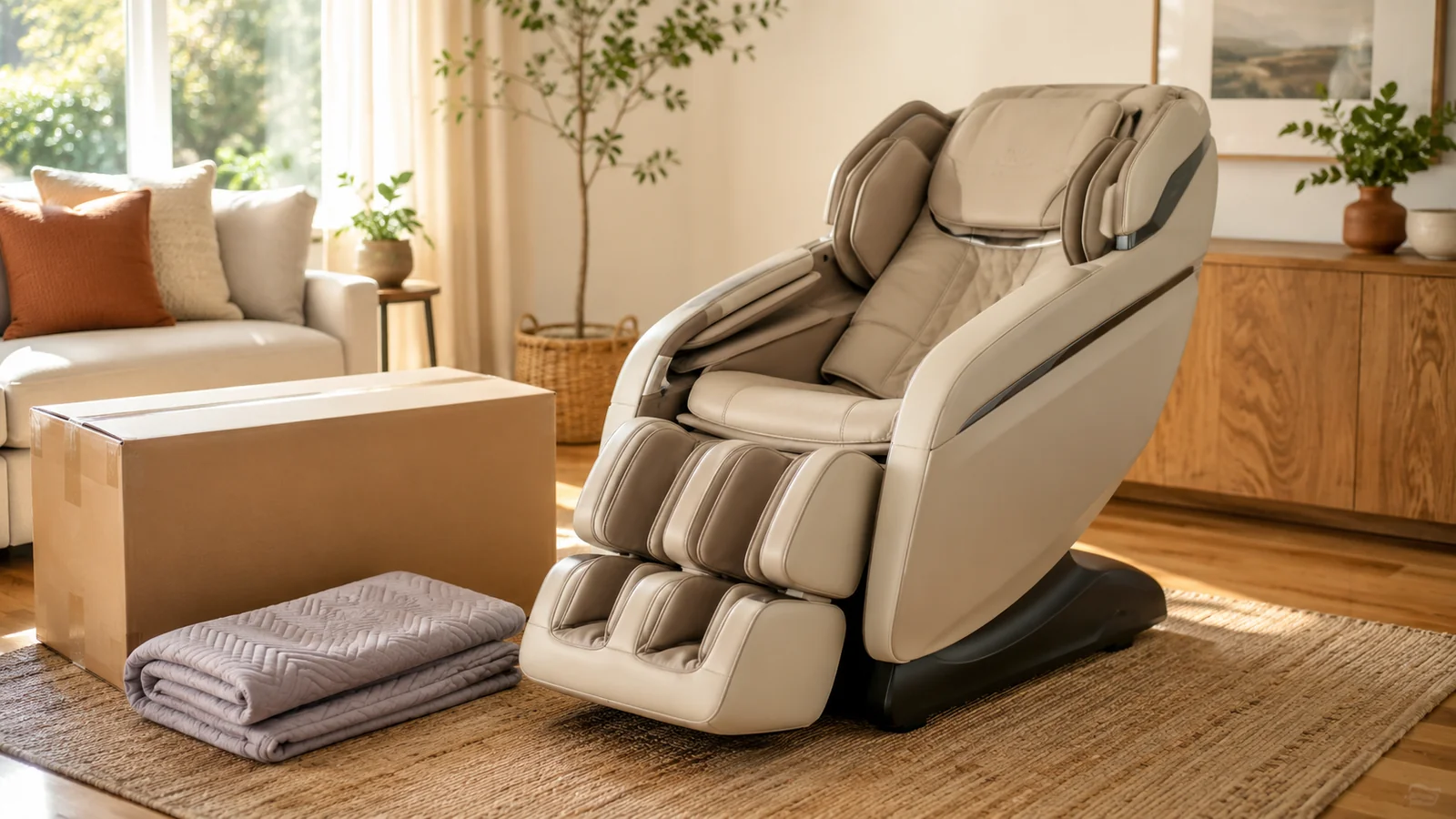
Online buying may fit you when:
- The return policy is clear and in writing — window, fees and who pays return freight.
- Delivery and shipping costs are spelled out, including curbside versus room-of-choice setup.
- Warranty support is written, and you know who to contact for a repair.
- The service process is understandable before you order, not after.
- You’ve tested a similar chair before, or you accept the comfort risk of buying unseen.
- Reviews are detailed and specific to the exact model and version.
- The total ownership cost is transparent, not hidden behind a single low figure.
- You don’t need an in-person comparison to feel confident.
The trade-off is that you can’t sit in the chair before it arrives, so the homework shifts to reading carefully. Our guide on how to read massage chair reviews helps you weigh what online listings and third-party write-ups are really telling you.
Online buying risks to check first
None of these make online buying unsafe — they’re simply the things to confirm in writing before you order a heavy, high-ticket item you can’t test first. Tick each as you verify it.
Tick items as you confirm them. Progress is saved on this device only — no account, no email.
When a showroom visit can reduce risk
A showroom’s strength is the body test. You can sit in the chair, run a full program, feel whether the rollers reach your neck and lower back, and compare two or three models side by side in a single afternoon. You can also ask questions in real time and watch how staff answer, which tells you something about the seller. A visit tends to pay off most when comfort and fit are the open questions.
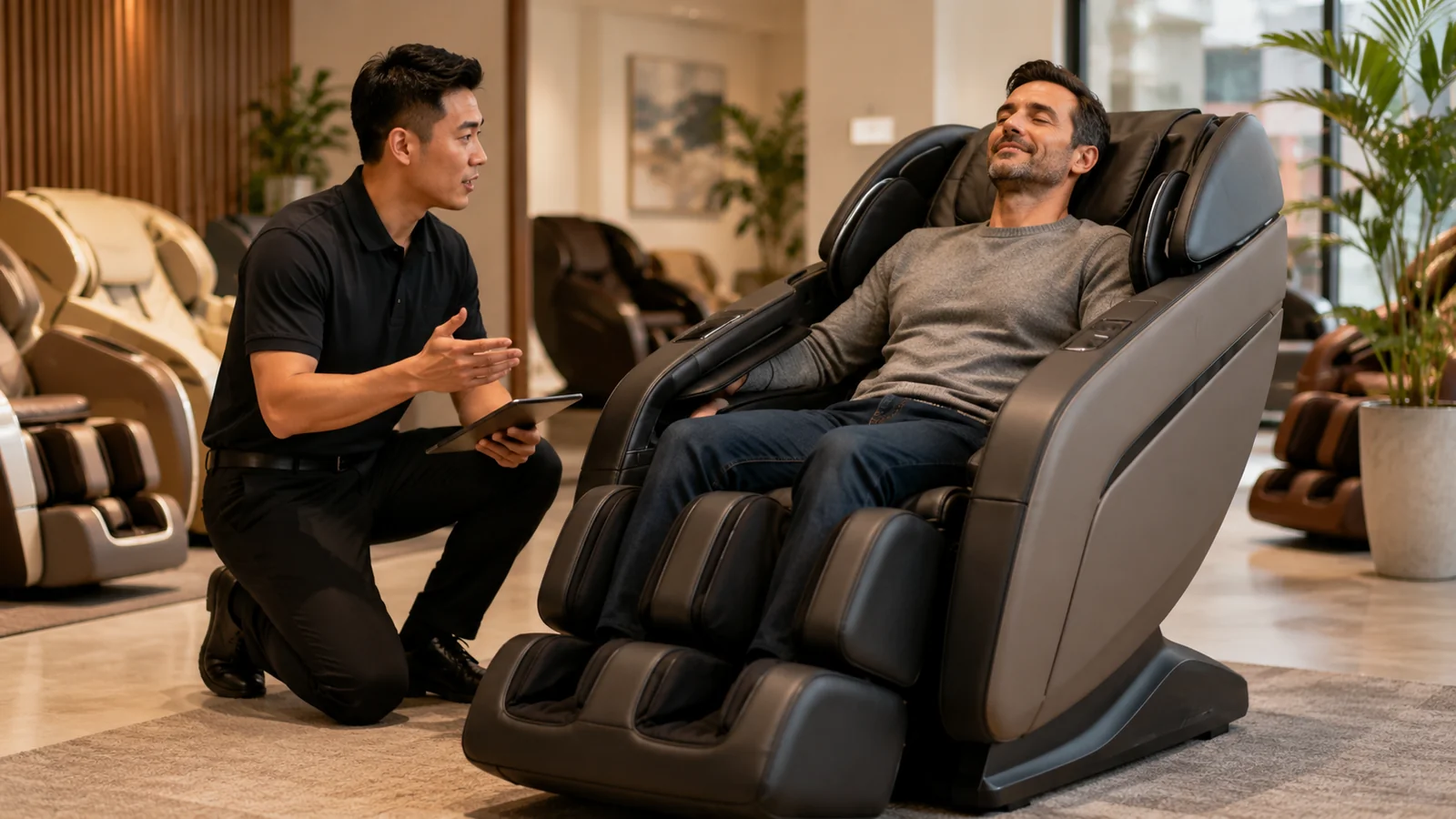
A showroom visit can help when:
- The chair is expensive and you want to feel it before committing.
- Comfort or body fit is uncertain.
- You’re short, tall, or sensitive to pressure, so generic height ranges feel risky.
- A spouse or co-decision-maker needs to try it too.
- Several models look similar online and you can’t tell them apart on paper.
- Delivery or installation is complex and you want it explained.
- Service or warranty questions matter and you’d rather ask in person.
- You want to compare brands side by side before deciding.
Try-before-buy: what a visit is for
The point of a visit isn’t to buy on the spot — it’s to learn what fit and intensity feel right for your body, so you can decide calmly afterward. If you’d like to try a massage chair before buying, our guides explain what to test and what a credible floor looks like.
What a showroom can and cannot prove
Testing in person reduces comfort risk, but it isn’t a guarantee. It’s worth being clear about what a visit settles and what it can’t, so a good demo doesn’t stand in for the rest of your homework.
A showroom can help with
- Body fit for your frame
- Pressure preference, felt directly
- How the controls work
- Recline and zero-gravity feel
- Foot and calf fit
- Comparing a few models side by side
- Staff guidance and how questions are answered
- Warranty, service and delivery questions, asked in person
A showroom cannot prove
- Long-term satisfaction with the chair
- How a future service request will go
- Any medical benefit
- Your exact day-to-day routine at home
- That every model will stay available forever
In other words, a showroom answers the comfort and fit questions a listing can’t — but warranty, service, delivery and total ownership still need the same scrutiny you’d apply online.
Reviews and specs: useful but limited
Specifications and reviews are valuable research tools, and they matter even more online, where you can’t test fit first. But each has limits worth knowing. Specs help you compare dimensions and features; reviews show patterns. Neither proves how a chair will feel for your body.
- Product reviewsHow the chair feels, fits, sounds and holds up over time.
- Retailer reviewsHow the seller communicates, prices, and stands behind the sale.
- Delivery & service reviewsHow delivery, installation and later repairs actually went.
A few things reviews and specs simply can’t settle: a star rating doesn’t prove service quality, product photos don’t reveal delivery or space-fit problems, and a wall of generic five-stars tells you less than a handful of detailed, recent accounts about the exact model.
Specs and reviews vs in-person testing
| What you’re judging | Specs & reviews | In-person testing |
|---|---|---|
| Body fit | Height range and dimensions suggest fit | Confirms alignment for your frame |
| Pressure preference | Described in words and star ratings | Felt against your own preference |
| Recline feel | Listed as angles and zero-gravity modes | Judged for support and ease |
| Foot & calf fit | Stated leg-rest extension range | Checked against your own legs |
| Noise & everyday feel | Rarely captured in specs | Heard and felt directly |
| Long-term satisfaction | Hinted at by review patterns over time | Not proven by a single visit either |
Warranty, service and delivery: comparing both routes
Whichever door you choose, the after-sale experience shapes years of ownership. The questions don’t change between online and showroom — only how you get the answers. Confirm each in writing before you commit.
| What to confirm | Buying online | Visiting a showroom |
|---|---|---|
| Warranty explanation | Read the written terms before ordering | Ask, and get the terms in writing |
| Service contact | Confirm who handles repairs and how to reach them | Ask who services the chair locally |
| Delivery method | Curbside or room-of-choice — confirm which | Often arranged locally; confirm scope |
| Installation | Check whether assembly is included | Ask whether setup is part of delivery |
| Room placement | Verify doorways, stairs and wall clearance yourself | Ask staff to confirm space and access needs |
| Returns / cancellations | Read window, fees and who pays return freight | Confirm the policy even after testing |
| Damaged delivery | Know the claim process before it happens | Ask how a damaged unit is handled |
| Post-purchase support | Find the named support path before ordering | Confirm a person or process to call later |
Amazon, Costco and marketplace buying
Marketplaces and big-box retailers can be convenient places to buy, and a generous return policy is often part of the appeal. The thing to remember is that convenience doesn’t remove ownership risk — the same five questions about fit, returns, delivery, warranty and claims still apply. The extra step on a marketplace is confirming exactly who you’re buying from.
Marketplace seller identity: what to verify
A Costco massage chair or an Amazon massage chair can be a perfectly reasonable choice — the goal isn’t to avoid any seller, but to confirm the model, the seller, the warranty path and the return terms before you buy, exactly as you would anywhere else.
Price vs total ownership cost
The sticker price is rarely the whole cost, and a lower price doesn’t always mean lower ownership cost. Delivery, installation, returns, warranty and service all add up over the years you’ll own the chair. Compare the total ownership cost across similar service levels — and make sure financing terms (rate, length and total repaid) are clear — rather than deciding on the headline number alone.
| Cost factor | What the price may show | What ownership adds |
|---|---|---|
| Purchase price | The headline number | The starting point, not the total |
| Delivery | May be excluded or curbside only | Room-of-choice or white-glove can cost more |
| Installation | Sometimes not included | Assembly and placement may be extra |
| Returns | Looks free until you read the terms | Return freight and restocking can apply |
| Warranty & service | A length in years | Parts, labor and call-out fees over time |
| Financing | A low monthly figure | Rate and term decide the true total |
Compare like with like: a lower price with curbside drop-off and limited support isn’t the same deal as a higher price with white-glove delivery and in-home service. Price is one factor, weighed alongside risk and support.
Medical-sounding claims, online and in showrooms
Online pages and showroom staff alike may use wellness language, and most of it is fine. Comfort and relaxation claims are simply different from treatment claims, and it helps to tell them apart calmly on either route.
A note, not a warning
Be cautious with claims that a chair treats, cures, or prevents conditions — or about chronic pain, circulation, neuropathy, arthritis, recovery or disease — and with phrases like “clinically proven,” “doctor recommended,” “FDA approved” or “medical-grade.” Reviews don’t prove medical outcomes, and a showroom test can show comfort, pressure and preference but not medical treatment. If you have a diagnosed condition, consult a healthcare professional before buying.
“Designed for comfort and relaxation; may help you unwind and ease minor muscle tension.”
Describes comfort, sets fair expectations.“Clinically proven to treat back pain and improve circulation — doctor recommended.”
Treatment-style and absolute; ask for evidence.Massage chairs should be evaluated for comfort, relaxation, pressure preference, body fit, and temporary relief of minor muscle tension. They should not be treated as a substitute for medical diagnosis or treatment.
Decision framework: which buying path fits you?
Neither column is the “right” answer — it’s about which route lets you answer every question with confidence. Read both, and lean toward the one where more lines feel true for you.
Choose online if
- You understand the return and service risk
- The exact model and version are clear
- Support terms are written down
- The comfort risk of buying unseen is acceptable
- Price and total value are transparent
- Delivery and installation terms are clear
Choose a showroom if
- Fit and comfort matter and feel uncertain
- Your model choice isn’t settled yet
- The chair is expensive
- More than one person will use it
- Delivery or service needs explaining
- You want to compare models in person
Plenty of buyers do both: test in a showroom to settle fit, then decide where to complete the purchase based on returns, delivery, warranty and overall confidence in the seller. Whichever route you land on, vet the seller the same way.
Online vs showroom checklist
Before buying anywhere — online or in a showroom — confirm you can tick every line below. If one is missing an answer, that’s the question to resolve before you commit.
Tick items as you confirm them. Progress is saved on this device only — no account, no email.
Before you decide
Save this checklist before you buy online or visit a showroom
Keep it with you on either route. Save or print a clean copy — no email, no sign-up, nothing to buy.
Your ticked items are stored on this device only. We never ask for your email to use this checklist.
How we compare buying channels
We compare online and showroom buying on consumer decision criteria, not sales goals: comfort risk and body fit, warranty and service clarity, delivery and installation, return complexity, review quality, total ownership cost, and responsible claim language. We are an independent guide — we don’t sell chairs, run a showroom, or take payment to rank or feature anyone, and we don’t rank retailers or brands.
If you’re comparing brands online
The same brand names reappear across listings and showroom floors. Recognizing them helps you orient, but a brand or model review only means something when you pair it with the same warranty, service, delivery and fit checks you’d apply to any chair. Brands you may come across include:
- Bodyfriend
- Cozzia
- D.Core
- Infinity
- Kyota
- Ogawa
- OHCO
- Osaki
- Panasonic
Listed alphabetically to help you recognize the market — not ranked, not endorsed, and not all tested. Compare any brand against the same practical criteria.
If you want to test in person
If you’d like to try chairs before deciding, these guides explain what to look for locally — what to compare, not where to shop. They’re guidance, not directories.
California showroom guidance
What makes a California massage chair showroom worth visiting, and how to compare before you go.
California guidanceBay Area showroom guidance
How to evaluate showrooms across the Bay Area — including Santa Clara and Valley Fair, and San Jose and Oakridge — using one neutral checklist.
Bay Area guidanceFrequently asked questions
Should I buy a massage chair online or in a showroom?
Both routes work. Buying online is convenient and offers wider selection when the return policy, warranty, delivery, installation and service are clear in writing. A showroom lowers comfort and body-fit risk because you can test pressure, recline and controls in person. The safer choice depends on your risk tolerance, budget, fit concerns and support expectations — not price alone. Many buyers test in a showroom, then choose where to buy.
Is it safe to buy a massage chair online?
For many buyers, yes. Buying a massage chair online is reasonably safe when you confirm the exact model, read the return policy and who pays return freight, verify warranty and service coverage, and understand the delivery method before ordering. The main trade-off is that you can’t test fit first, so a clear return window and detailed, model-specific reviews matter more.
What are the risks of buying a massage chair online?
The main risks are comfort and body-fit uncertainty, return complexity on a heavy item, unclear delivery or installation, and warranty or service that’s hard to use later. On marketplaces, also confirm the seller’s identity and warranty eligibility. None of these make online buying unsafe — they’re simply the things to verify in writing before you order.
Is Costco a good place to buy a massage chair?
Costco can be a convenient option, and its return policy is often a draw. As with any retailer, confirm the exact model, what delivery and installation include, how warranty and service are handled, and who to contact for repairs. Compare the total ownership cost and support level against other sellers rather than deciding on price or membership perks alone.
Is Amazon safe for massage chairs?
Amazon can be safe, but check the details before buying. Confirm whether the seller is the brand or a third party, whether the warranty applies through that seller, and how returns and return shipping work on a bulky item. Read delivery and service reviews, not just product star ratings, and verify the listing matches the current model and version.
Should I test a massage chair before buying online?
If you can, testing first helps a lot. Comfort, pressure and body fit are personal, and a few unhurried minutes in the exact model reveals what specs and photos can’t. A common approach is to try a massage chair before buying in a showroom, then decide where to purchase. If testing isn’t possible, lean on a strong return policy and detailed reviews.
What do online reviews not tell me?
Reviews show patterns, but they can’t prove how a chair will feel for your body or pressure preference. Star ratings don’t measure service quality, and product photos don’t reveal delivery or space-fit problems. Reviews also mix feedback about the chair, the retailer, and delivery or service. Read for recent, specific, model-matched patterns rather than a single rating.
What return policy should I check before buying a massage chair?
Read the return window, any restocking fee, and who pays return shipping for a heavy chair. Confirm what “like new” condition means, whether original packaging is required, and how a cancellation works before delivery. The massage chair return policy matters most online, where you can’t test fit first, but it’s worth confirming in a showroom too.
What should I compare besides price?
Compare comfort and body fit, the return policy, delivery method and installation, warranty coverage, service contact, and review patterns — then total ownership cost across similar service levels. A lower price with curbside drop-off and weak support isn’t the same deal as a higher price with white-glove delivery and in-home service. Weigh price with risk and support, not alone.
When is a showroom visit worth it?
A showroom visit is worth it when the chair is expensive, comfort or fit is uncertain, you’re short, tall or sensitive to pressure, or someone else will share the chair. It also helps when several models look similar online, or when delivery, warranty and service need explaining. Testing in person lowers comfort risk before a major purchase.
One last step
Compare online and showroom risks before deciding
Whichever route you choose, the same questions protect a high-ticket purchase. Run the checklist, and if fit is the open question, go feel a chair for yourself.
Last updated: July 2026 · Editorial standards · Disclosure