Short answer
Massage chairs are commonly marketed for comfort, relaxation, a stress reset, and the temporary relief of minor muscle tension. The massage chair health claims worth slowing down for are the ones that sound like treatment, cure, or disease management — for example, claims about improving circulation, easing neuropathy, arthritis, sciatica, or chronic pain, or delivering medical recovery. Those go further than comfort, so they call for evidence, regulatory context, and careful reading. A massage chair is a comfort-and-relaxation product, not a substitute for care; for any diagnosed condition, the right next step is a healthcare professional.
Please read first
This guide is for consumer education only and is not medical advice. Massage chairs should not be used as a substitute for medical diagnosis, treatment, or professional healthcare guidance. If you have a diagnosed condition, injury, circulatory issue, implanted device, pregnancy-related concern, chronic pain, or another medical concern, consult a healthcare professional before using a massage chair. Our medical disclaimer explains this boundary in full.
Key takeaways
- This page helps you ask better questions before trusting a health-related claim — it does not accuse any brand or retailer, and it is not a verdict on anyone.
- Comfort language (“relaxing,” “temporary relief of minor muscle tension”) describes an experience; treatment language (“treats,” “cures,” “improves circulation”) implies a medical outcome and needs stronger evidence.
- Reviews and showroom demos can tell you a lot about comfort and fit — but they do not prove a medical benefit.
- Terms like “medical-grade,” “FDA approved,” “doctor recommended,” and “clinically proven” carry specific meanings and deserve a clear, checkable source.
- For anything related to a diagnosed condition, treat a chair as comfort, not treatment, and ask a qualified healthcare professional.
Key terms
- Comfort claim
- A statement about how a chair feels or what experience it offers — “relaxing,” “soothing,” “helps you unwind.” It describes a sensation, not a medical result.
- Wellness claim
- Broad lifestyle language about everyday well-being — a “daily relaxation routine,” “stress reset,” or “home wellness.” It sits between comfort and treatment and is worth reading for how specific it gets.
- Treatment claim
- A statement that a product acts on a disease, injury, or diagnosed condition — that it treats, cures, heals, or prevents something. This is the type of claim that calls for evidence and regulatory context.
- Medical-sounding claim
- Language that borrows clinical or official authority — “medical-grade,” “clinically proven,” “doctor recommended” — without necessarily meeting a medical standard. Treat it as a claim to verify, not a guarantee.
- Medical device
- A product regulated for a medical purpose. Marketing words like “therapy” or “medical-grade” do not, on their own, mean a chair is a regulated medical device. Ask for the exact regulatory context.
- Evidence / substantiation
- The proof behind a claim — named, checkable sources rather than a vague mention of “studies.” Stronger claims need stronger, product-specific substantiation.
- Temporary relief of minor muscle tension
- A modest, responsible phrasing describing a short-lived comfort experience after use. It does not promise to fix a medical problem.
Why massage chair health claims need careful reading
When you shop for a massage chair, you meet two very different kinds of language. Some of it is honest and measured — it talks about comfort, relaxation, and easing everyday muscle tension. Some of it quietly drifts toward medical territory, hinting that a chair will act on a condition. Learning to tell them apart helps you set fair expectations and protect your health decisions. This is a calm lens, not a warning siren.
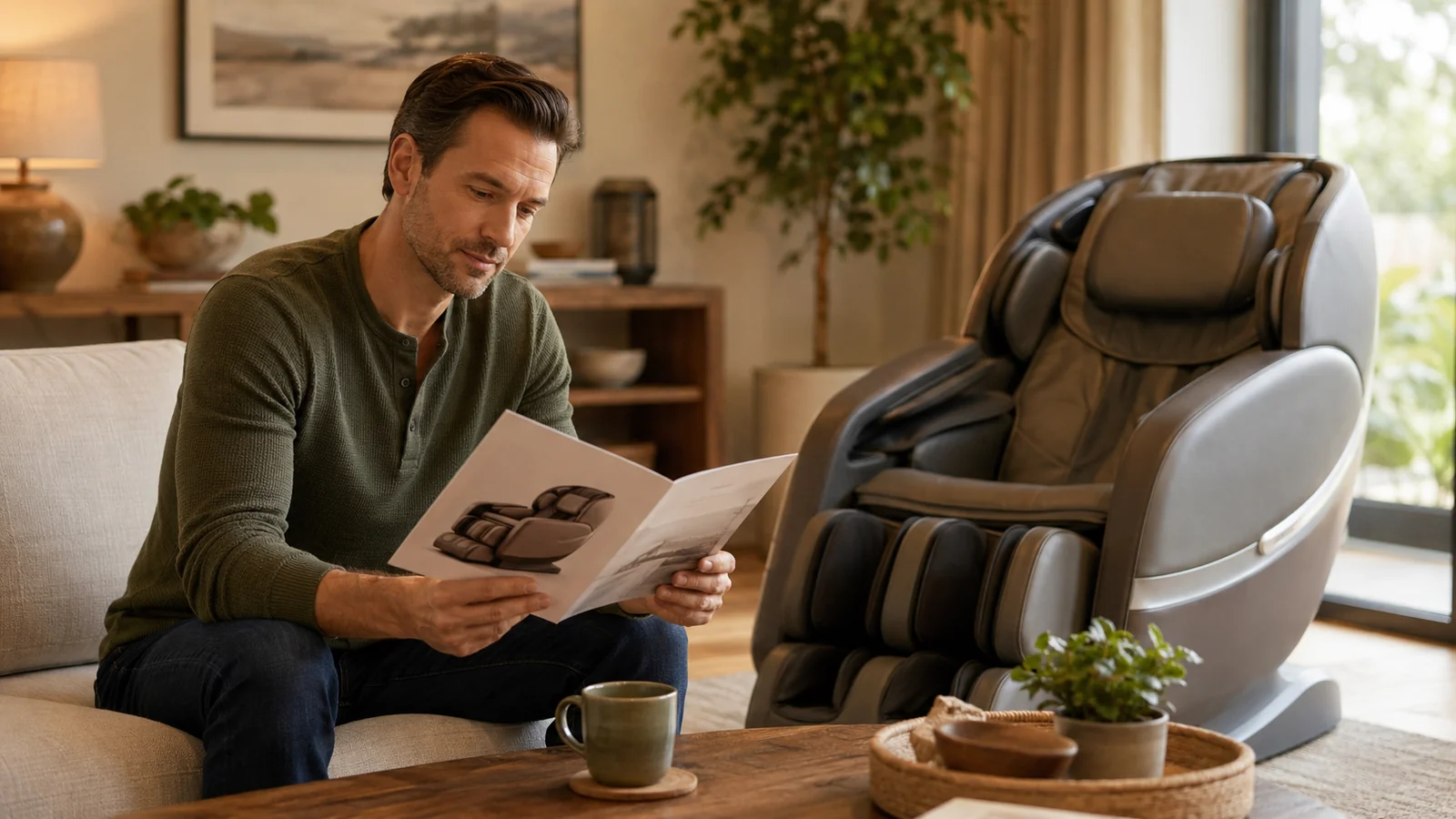
It matters because buyers are often researching at a vulnerable moment — tired, sore, stressed, or worried about a health issue. That is exactly when a confident-sounding promise is most persuasive and least examined. Strong claims should be backed by appropriate evidence; comfort language and treatment language are not the same thing; and no number of positive reviews turns a relaxation product into a proven medical one.
The goal here is not to decide that any particular claim is false or improper. It is to give you a few plain-English habits for reading massage chair medical claims so you can ask, calmly, “What is this actually promising, and what would back it up?”
Safe vs risky claim language
Responsible massage chair wellness claims describe how a chair feels and what experience it offers, without overpromising. Riskier language makes a medical leap — and the bigger the leap, the more evidence and context it should come with. Here is the safer vocabulary you can generally take at face value:
- Comfort
- Relaxation
- Stress reset
- Pressure preference
- Body fit
- Temporary relief of minor muscle tension
- Daily relaxation routine
- Home wellness routine
| Topic | Safer comfort language | Riskier language to evaluate |
|---|---|---|
| Muscles & pain | “May help ease minor muscle tension temporarily.” | “Treats back pain,” “relieves sciatica,” “cures pain.” |
| Relaxation & stress | “Designed to help you relax and unwind.” | “Reduces stress hormones,” “treats anxiety.” |
| Body function | “A comfortable, supported reclining position.” | “Improves circulation,” “boosts immunity.” |
| Conditions | “For everyday comfort and relaxation.” | “Treats neuropathy / arthritis,” “disease management,” “rehabilitation.” |
| Authority | “Customers tell us it feels soothing.” | “Medical-grade,” “FDA approved,” “doctor recommended,” “clinically proven.” |
Riskier wording is not automatically wrong — but it shifts the burden onto the seller to show appropriate, product-specific evidence and the right regulatory context.
Claim type risk levels
A simple way to triage any claim: how far does it travel from “how it feels” toward “what it does to a condition”? The further it travels, the more caution and evidence it warrants.
| Claim type | Caution level | A sensible buyer response |
|---|---|---|
| Comfort & relaxation | Lower | Generally fine to read at face value. Judge it by how the chair actually feels for you. |
| Stress, sleep & recovery routine | Moderate | Fair as lifestyle framing, but notice if it edges toward a measurable medical result. Keep expectations modest. |
| Treatment, cure & disease claims | Higher | Ask what evidence supports the claim, whether it applies to this exact model, and what a healthcare professional would say. |
Comfort claims vs treatment claims
The clearest line to hold is between a claim about your experience and a claim about your medical condition. A comfort claim describes a feeling. A treatment claim promises an outcome on a disease or injury. When you can name which one you are reading, most of the confusion falls away.
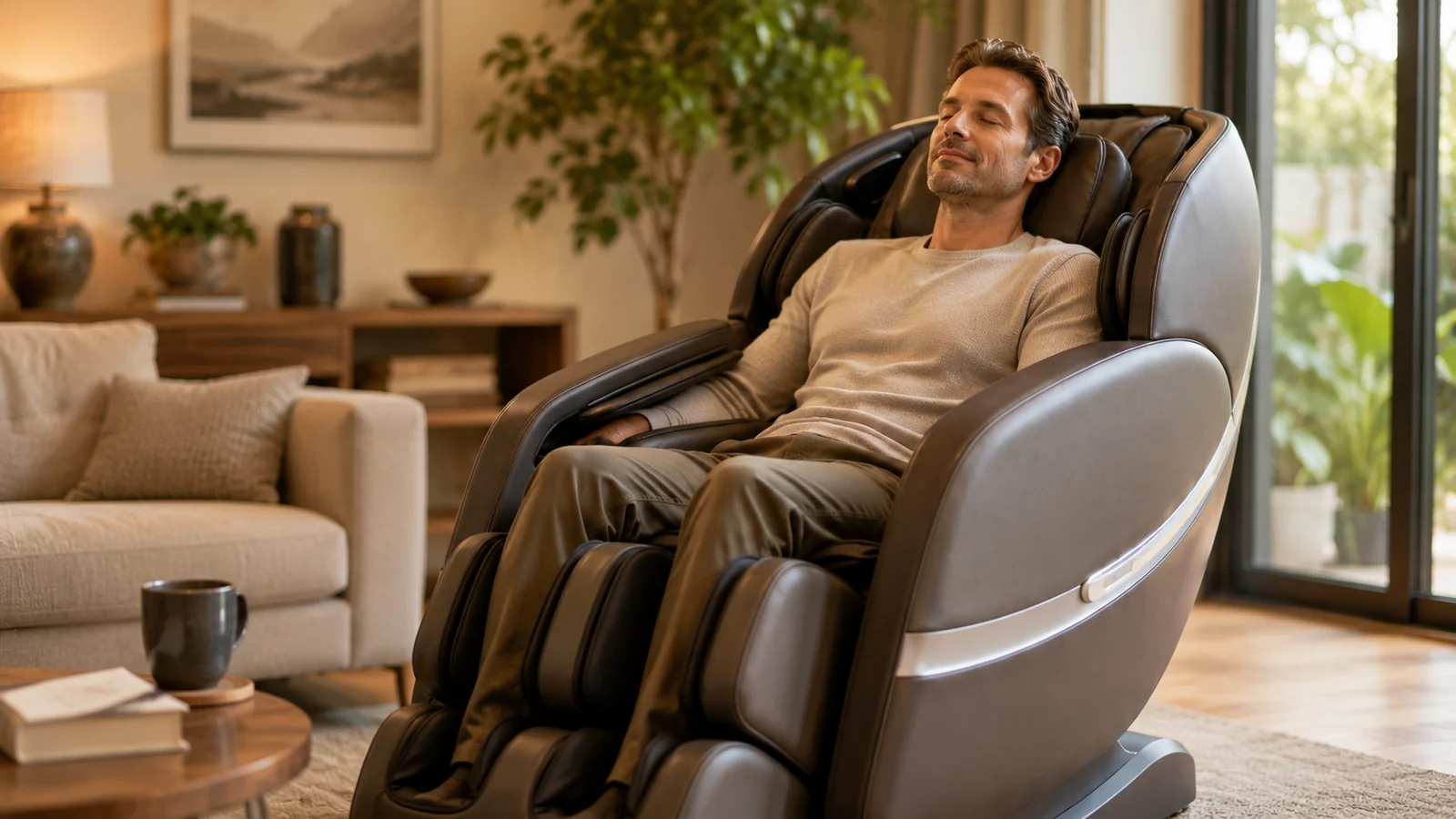
Describes how it feels. “Helps you relax,” “eases minor muscle tension temporarily,” “a supported recline.”
How to read it: take it as an experience to test for yourself. A showroom demo or a home trial can confirm whether it is true for you.
Implies a medical outcome. “Treats back pain,” “improves circulation,” “relieves arthritis.”
How to read it: ask what evidence supports it, whether it applies to this exact chair, and whether a qualified professional would agree.
A review that says “I felt better” is honest and useful, but it is not the same as clinical proof, and a comfortable demo shows comfort — not treatment. Keeping that distinction in mind is the single most useful habit for reading massage chair therapy claims without being misled.
Common medical-sounding claims buyers see
Below are claims you may encounter, with what each tends to sound like, why it is worth a pause, what to ask before trusting it, and a calmer way to think about it. None of these is automatically false, and none is described here as illegal — the point is simply that the stronger the claim, the more evidence, context, and care it deserves.
Back pain claims
Sounds like: “Relieves back pain” or “targets chronic back pain.”
- Why pause
- Back pain has many causes; a comfort product easing tension for a while is different from treating a diagnosed cause.
- What to ask
- Is this a comfort claim or a treatment claim? What evidence supports it, and does it apply to my situation?
- Safer framing
- Think of it as possible temporary relief of minor, everyday muscle tension — and a question for your clinician if pain is ongoing.
Circulation claims
Sounds like: “Improves circulation” or “boosts blood flow.”
- Why pause
- This is a measurable physiological claim — exactly the kind that needs named evidence and the right regulatory context.
- What to ask
- What study supports this for this specific chair, and what are its limits? Is the wording about feeling or about a medical effect?
- Safer framing
- Treat massage chair circulation claims as claims to verify. If circulation is a medical concern for you, ask a healthcare professional.
Neuropathy claims
Sounds like: “Helps with neuropathy” or “eases nerve discomfort.”
- Why pause
- Neuropathy is a diagnosed neurological condition. For some people, certain pressure may even be inadvisable.
- What to ask
- Is there evidence for this exact use, and is there a clear caution to consult a professional first?
- Safer framing
- Treat this strictly as a question for a clinician, not as a feature to buy on. A chair is comfort, not nerve care.
Arthritis claims
Sounds like: “Relieves arthritis” or “for joint pain.”
- Why pause
- Arthritis is a medical diagnosis with many forms; “relieves” implies a clinical outcome a relaxation product is not built to promise.
- What to ask
- Is the wording about comfort, or about treating the condition? What backs the stronger version, and for whom?
- Safer framing
- Consider whether the chair simply feels good to sit in — and let a healthcare professional guide anything about the condition.
Sciatica claims
Sounds like: “For sciatica” or “relieves sciatic pain.”
- Why pause
- Sciatica relates to a specific nerve and underlying cause; intensity that suits one person may not suit another.
- What to ask
- What evidence applies to this model, and is there guidance to check with a professional before regular use?
- Safer framing
- Read it as a comfort question to test gently, and a medical question to take to your clinician.
Sleep and stress claims
Sounds like: “Improves sleep” or “melts away stress.”
- Why pause
- Relaxing before bed is a reasonable comfort idea; a claim to improve sleep as an outcome is a bigger, measurable promise.
- What to ask
- Is this lifestyle framing or a medical result? Does the wording stay modest about what it can do?
- Safer framing
- A calming routine may feel good. Treat sleep disorders and ongoing stress as topics for a healthcare professional.
Recovery claims
Sounds like: “Speeds muscle recovery” or “for post-workout recovery.”
- Why pause
- “Recovery” can mean simply feeling looser, or it can imply a measured athletic or medical effect — two very different claims.
- What to ask
- Which meaning is intended, and what evidence supports the stronger one for this chair?
- Safer framing
- Feeling relaxed after exercise is a comfort experience. Treat performance or rehabilitation claims as claims to verify.
AI body scan claims
Sounds like: “AI body scan tailors a medical-level massage to you.”
- Why pause
- A body scan that adjusts roller position for fit is a comfort feature; framing it as diagnosing or treating you is a much larger claim.
- What to ask
- Does the scan adjust comfort and fit, or is it being presented as a medical assessment? What supports the latter?
- Safer framing
- Value it for a better physical fit, not as a substitute for a professional assessment.
Medical-grade claims
Sounds like: “Medical-grade massage chair” or “clinical-quality therapy.”
- Why pause
- “Medical-grade” is a marketing phrase with no single fixed meaning; it does not, by itself, confirm any regulatory status.
- What to ask
- What exactly does “medical-grade” refer to here, and is there a checkable regulatory or evidentiary basis?
- Safer framing
- Treat the phrase as a prompt to verify rather than a guarantee. A medical-grade massage chair label is a claim to evaluate.
Doctor recommended claims
Sounds like: “Doctor recommended” or “chiropractor endorsed.”
- Why pause
- An endorsement can be broad or vague — which doctors, for what, and on what basis is often unstated.
- What to ask
- Who specifically, in what context, and is it about general comfort or about treating a condition?
- Safer framing
- Treat “doctor recommended” as a claim to verify, and rely on your own healthcare professional for advice about you.
Are massage chairs medical devices?
It is reasonable to wonder whether a chair counts as a medical device, especially when marketing uses words like “therapy,” “medical-grade,” or “clinical.” The short version: those words alone do not settle the question. Most massage chairs are sold as comfort-and-relaxation products, and language that sounds medical is not the same as a documented medical-device status.
Regulatory terms are also easy to blur in marketing. Phrases such as “FDA registered,” “listed,” “cleared,” “approved,” “classified,” or “exempt” can mean quite different things, and a casual “FDA approved” in an ad may not carry the meaning a shopper assumes. The consumer-safe move is not to make a legal judgement yourself, but to ask for the exact regulatory context and a checkable source.
Worth verifying
If a chair’s status as a regulated medical device matters to your decision, ask the seller to point to the specific regulatory record or evidence in writing — and confirm it refers to the exact model you are considering. Treat vague “medical-grade” or “FDA approved” wording as a claim to check, not a conclusion to accept. This guide does not determine any specific product’s regulatory status.
Can reviews prove health benefits?
Reviews are valuable — but for the right things. They can describe personal experiences, surface comfort patterns across many owners, and flag practical issues. What they cannot do is prove a medical outcome. A reviewer’s body, condition, usage, and expectations all vary, so a glowing health story is an anecdote, not evidence that the same result applies to you.
One person’s experience. “My back felt better after a week.”
Useful for: spotting comfort patterns, fit notes, and recurring service or delivery themes when many reviews agree.
Substantiation behind a claim. A named, checkable source that applies to this exact model.
Needed for: any medical-sounding claim. The bigger the promise, the stronger and more specific the evidence should be.
So read medical-sounding reviews as stories, not proof — while still using the same reviews to learn about comfort, fit, and how the seller handles delivery and service.
What to ask a retailer about health or wellness claims
You do not need a science background to pressure-test a claim — a few calm questions usually reveal how much is behind it. Tick these as you get clear answers. Your progress is saved on this device only, with no account and no email.
What showroom testing can and cannot prove
An in-person test is one of the best ways to reduce comfort risk on a high-ticket purchase. It is genuinely informative — about comfort. It is not a way to confirm a medical benefit. Holding that line keeps a good demo from being read as proof of treatment.
Comfort · pressure preference · body fit · controls · recline feel · ease of use · whether the chair feels too intense.
Treatment of disease · long-term medical benefit · circulation improvement · chronic-pain outcomes · recovery results · medical effectiveness.
In other words, let a visit answer “does this feel right for my body?” — and leave “will this treat my condition?” to evidence and a healthcare professional.
Claim safety checklist
Before trusting any health-related claim, run it through these nine questions. If several answers are vague, that is your cue to ask for more — not a verdict against the seller, just a reason to slow down before money changes hands.
Tick items as you work through a claim. Progress is saved on this device only — no account, no email. Print this checklist.
Medical disclaimer and buyer safety
None of this is meant to alarm you — a massage chair is, for most people, a pleasant comfort product. It is simply about using it sensibly and keeping medical decisions where they belong.
Buyer safety
This is not medical advice. Consult a healthcare professional for anything related to a diagnosed condition, and do not rely on a chair in place of medical care. Stop use if something feels wrong rather than “worked.” Use extra caution — and check with a professional first — if any of the following apply to you:
- Pregnancy or a pregnancy-related concern
- An implanted device, such as a pacemaker
- A circulatory issue, blood clots, or related conditions
- A recent injury, surgery, or post-surgical recovery
- Chronic pain or a diagnosed musculoskeletal condition
- Neurological symptoms or conditions, such as neuropathy
- Any other condition your healthcare professional is managing
When in doubt, a short conversation with a clinician is the safest, simplest way to know whether — and how — a massage chair fits your situation.
How we evaluate claim language
So you know where this guidance comes from: when we describe a claim, we look at the same handful of things and hold the same limits, every time.
- SpecificityIs the claim modest and precise, or sweeping and vague?
- Comfort vs treatmentDoes it describe an experience or imply a medical outcome?
- Evidence & contextIs there a named, checkable source and the right regulatory framing?
- Exact-product relevanceDoes the evidence apply to the specific model in question?
- LimitationsAre caveats, risks, and “who should be careful” made clear?
- Consumer riskCould the wording lead a vulnerable buyer to delay appropriate care?
And the limits we hold to: no legal accusation without verification, no medical advice, and no competitor attacks. Read more in our medical disclaimer, editorial standards, disclosure, and review methodology.
Reading brand or model claims?
The same brand names reappear across showrooms and listings. Recognizing them helps you orient — but claims should be judged by the exact product, its evidence, and its context, not by the brand on the badge. Different makers describe their chairs differently, so treat each claim on its own terms.
- Osaki
- Infinity
- Panasonic
- OHCO
- D.Core
- Positive Posture
- Ogawa
- Kyota
- Bodyfriend
Brands are listed to help you recognize the market, not as endorsements or rankings, and not all brands make the same claims. For a fair way to compare any brand on the same practical criteria, see our guide to brands to try before buying.
Planning to ask claim questions in a showroom?
If you will be visiting in person, a little preparation makes those conversations calmer and clearer. These guides cover what to test, who to trust, and how to tell a legitimate showroom from a pressured one.
Should you try a massage chair before buying?
What an in-person test can — and can’t — tell you about comfort and fit.
Plan a visitHow to choose a massage chair retailer
Compare transparency, warranty clarity, service, and how a seller talks about health.
Compare retailersWhat makes a massage chair showroom legitimate?
The trust signals worth checking before you visit or buy.
See the standardFrequently asked questions
Are massage chair health claims trustworthy?
Comfort and relaxation claims are generally fair to take at face value and easy to test for yourself. Medical-sounding claims — about treating pain, improving circulation, or managing a condition — are the ones to read carefully. Trust them only as far as the evidence goes: ask for a named, checkable source that applies to the exact chair, and treat a diagnosed condition as a question for a healthcare professional.
Can massage chairs treat back pain?
A massage chair is a comfort-and-relaxation product, not a medical device. It may help ease minor, everyday muscle tension temporarily and feel soothing, but “treats back pain” is a treatment claim that needs evidence and applies differently to different causes. If you have ongoing or diagnosed back pain, talk with a qualified healthcare professional about what is appropriate for you.
Are massage chairs medical devices?
Most are sold as comfort-and-relaxation products, and marketing words like “therapy” or “medical-grade” do not, on their own, make a chair a regulated medical device. Regulatory terms such as “registered,” “listed,” “cleared,” and “approved” mean different things. If device status matters to you, ask the seller for the exact regulatory context and a checkable source for that specific model.
Can massage chairs improve circulation?
“Improves circulation” is a measurable medical claim, so treat it as a claim to verify rather than a given. Ask what evidence supports it for the exact chair and whether the wording is about feeling or about a medical effect. If circulation is a health concern for you, ask a healthcare professional — a relaxation product is not a substitute for medical guidance.
What does “medical-grade massage chair” mean?
“Medical-grade” is a marketing phrase with no single fixed definition, so it does not by itself confirm any regulatory status or proven medical benefit. Ask exactly what it refers to and whether there is a checkable regulatory or evidentiary basis for this specific model. Until that is clear, treat “medical-grade” as a claim to evaluate, not a guarantee.
Can reviews prove massage chair health benefits?
No. Reviews describe individual experiences, and reviewers differ in body, condition, usage, and expectations, so a positive health story is an anecdote rather than proof. Reviews are still useful for spotting comfort patterns and recurring service or delivery themes. For medical-sounding claims, look for evidence and professional guidance instead of relying on testimonials.
What claims should I be cautious about?
Be cautious with anything that sounds like treatment, cure, or disease management: claims to treat back pain, neuropathy, arthritis, or sciatica; to improve circulation; or to deliver medical recovery. Borrowed-authority terms like “medical-grade,” “FDA approved,” “doctor recommended,” and “clinically proven” also deserve a checkable source. None is automatically false — they simply need stronger, product-specific evidence.
What should I ask a retailer about wellness claims?
Ask whether a claim is about comfort or treatment, what evidence supports it, and whether that evidence applies to the exact model. Check that limitations are explained, that the claim is in writing, and that there is a medical disclaimer. If a salesperson promises more than the written materials, slow down — and for any diagnosed condition, ask a healthcare professional.
Should I ask a doctor before using a massage chair?
For general comfort and relaxation, most people do not need to. But you should check with a healthcare professional first if you are pregnant, have an implanted device, have a circulatory issue, are recovering from injury or surgery, or live with chronic pain or a neurological condition. When in doubt, a brief conversation with a clinician is the safest way to decide.
What is safe language for massage chair benefits?
Responsible language stays modest and experiential: comfort, relaxation, a stress reset, pressure preference, body fit, and the temporary relief of minor muscle tension. It uses words like “may” and “temporary,” avoids naming diseases, and points anyone with a real health concern toward a professional. If wording stays at that level, it is usually a sign the seller is being honest about what a chair can do.
Before you buy
Understand claim language before buying
Knowing the difference between comfort language and medical-sounding promises makes for a clearer, calmer, more confident choice — with nothing to buy here.
Last updated: July 2026 · Editorial standards · Disclosure