Short Answer
Here is how to choose a massage chair retailer: judge the seller as carefully as the chair. A trustworthy retailer shows a clear business identity, transparent showroom or buying access, meaningful reviews, written warranty terms, a named service path, clear delivery and installation details, responsible wellness language, pricing or financing clarity, and reachable post-purchase support. Compare retailers by ownership confidence, not price alone.
Why the retailer matters as much as the chair
A massage chair is a high-ticket, long-term purchase: the motors, rollers, gears and upholstery stay with you for years, and at some point something may need a part, an adjustment or a service visit. Product quality alone is not enough. The warranty behind the chair, the people who perform repairs, how it is delivered, and whether support answers the phone two years from now all shape the experience far more than the spec sheet suggests.
The wrong retailer can quietly add ownership risk — a coverage gap, a repair with no clear path, a return policy you only discover after a problem. The right retailer reduces that uncertainty by putting the important terms in writing and explaining the service path before you pay. Price should be one factor among several, not the whole decision. None of this is a verdict on online sellers or showrooms — both can be excellent — it is simply a reason to look past the sticker.

- Retailer trust
- The degree to which a seller’s promises match what actually happens after you pay — that the price holds, the warranty is honored, the repair gets done, and someone answers when you call.
- Authorized dealer
- A seller a manufacturer recognizes to sell its products. It can be a useful signal, but only when it is verified and clearly sourced — it is not proof of good service on its own.
- Post-purchase support
- The help available after delivery: warranty claims, repairs, parts, questions and troubleshooting. It is the relationship that lasts as long as you own the chair.
- White-glove delivery
- A delivery service that brings the chair into the room of your choice, assembles it, tests it, and removes the packaging — rather than leaving a heavy box at the curb.
- Total ownership cost
- The full picture beyond the price tag: delivery, installation, warranty, service and any financing — the things that decide what a chair really costs to own.
- Responsible wellness language
- Honest wording about comfort, relaxation and the temporary relief of minor muscle tension — as opposed to medical-sounding claims that imply a chair treats a condition.
Quick retailer trust checklist
This is a massage chair retailer checklist you can work through as you shop — a thinking tool, not a sign-up. Tick what a seller actually demonstrates. You are not looking for perfection; you are looking for clear, confident, in-writing answers. Nothing is saved to an account or sent anywhere.
Confirm what a seller actually shows you as you read — it’s a thinking tool, not a sign-up. Your ticks are kept on this device only; nothing is sent.
Showroom access and try-before-buy
Showroom access is most valuable when comfort or body fit is uncertain — and it usually is, because how a chair feels is personal and a listing cannot prove it. Sitting through a full program tells you what photos never will. That said, an online retailer can be just as legitimate when its terms are transparent: a clear return window can stand in for a showroom visit if you cannot get to one.
The signal that matters is whether you can actually test, compare or return — and whether that access is offered as help rather than used as pressure. A good seller is happy for you to take your time; a physical showroom should never become a reason to decide on the spot.
Authorized dealer and business transparency
Before you trust a seller with a major purchase, confirm it is a real, consistent business. None of these checks is hard, and a transparent retailer makes them easy.
What to verify
- Business name stated plainly and used consistently.
- Address and contact information you can actually reach.
- Official dealer or authorized status when it is relevant — and verifiable.
- Website clarity: policies, contact and product details are easy to find.
- Google Business Profile that matches the rest of the seller’s identity.
- Consistent online identity across the site, listings and reviews.
- Written policies for warranty, returns, delivery and cancellation.
- Current product availability for the exact model you want.
A note on authorized status
Authorized-dealer status can be a helpful signal, but it is not a guarantee of good service on its own — and a seller is not automatically trustworthy simply because it carries certain brands. If a retailer claims authorized status, ask for confirmation you can verify with the manufacturer rather than taking the label at face value.
Warranty clarity
A warranty’s value lives in its details. Massage chairs are mechanical, and parts wear, so the questions below matter more than the headline length of coverage. Ask each one and look for clear, written answers.
- What does the warranty cover?
- Are parts covered, and for how long?
- Is labor covered, and who pays for it?
- Are the electronics and control boards covered?
- Is the frame covered?
- Is in-home service available, or do you ship the chair?
- Who handles warranty support — the retailer, the manufacturer or a third party?
- What is excluded?
- Are the terms written clearly and available before you buy?
Service and post-purchase support
A warranty is only as good as the people behind it. Years from now you want a real path to a fix, not a disconnected phone line. Ask how a hypothetical repair would actually unfold — a confident, specific answer is reassuring; a vague one tells you what to expect later.
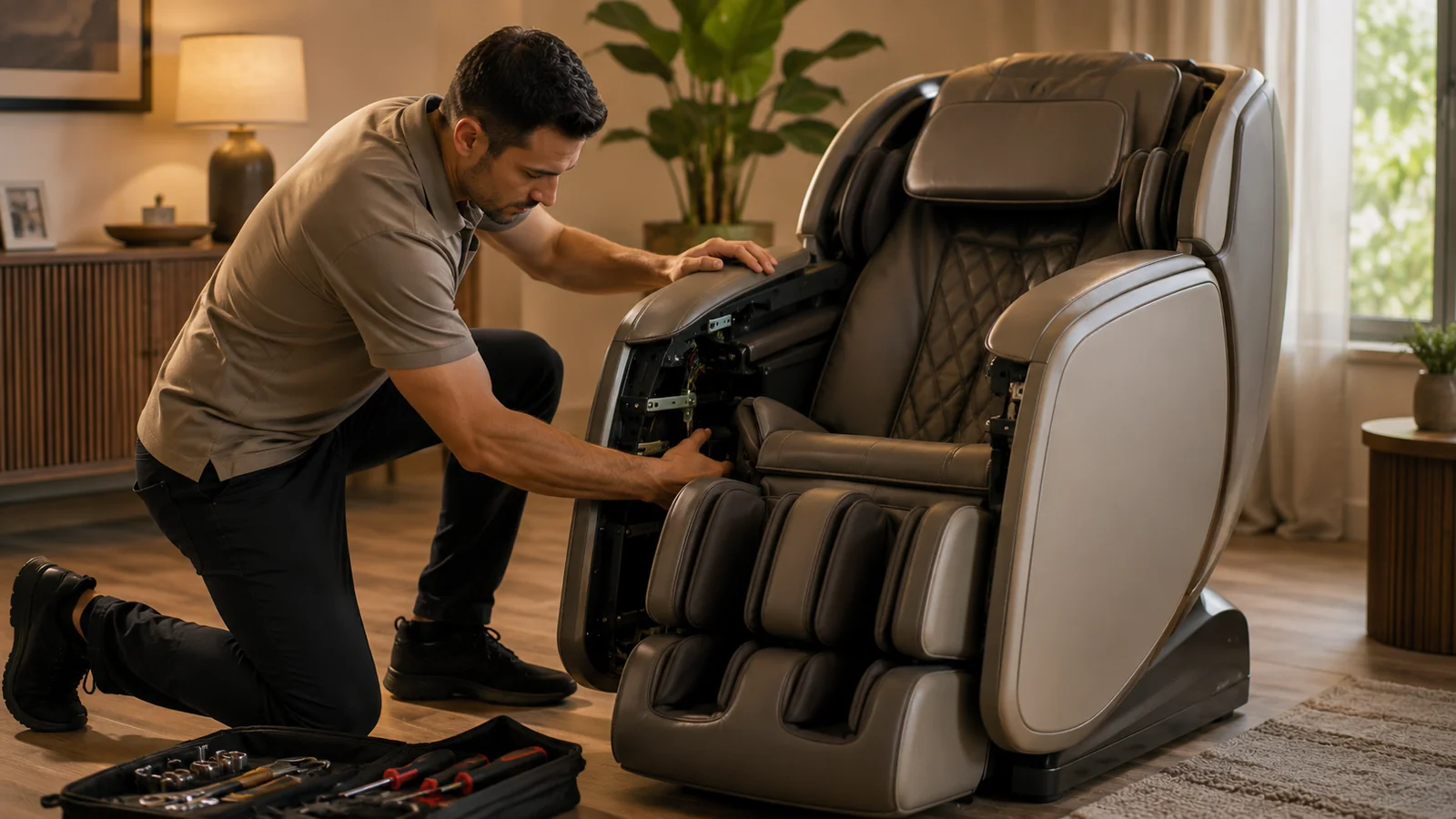
- Who do you contact for service?
- Is support local, manufacturer-based or third-party?
- Are parts available, and for how long?
- What happens if a repair is needed — remote help, mailed parts, or an in-home technician?
- How is service requested?
- How long might service typically take?
- Is the support process explained before purchase, not after?
Delivery, installation and space-fit
These chairs are heavy and bulky, often well over a hundred pounds in a large box, so getting one into a second-floor room is not a given. Sort out the practical details before you order.
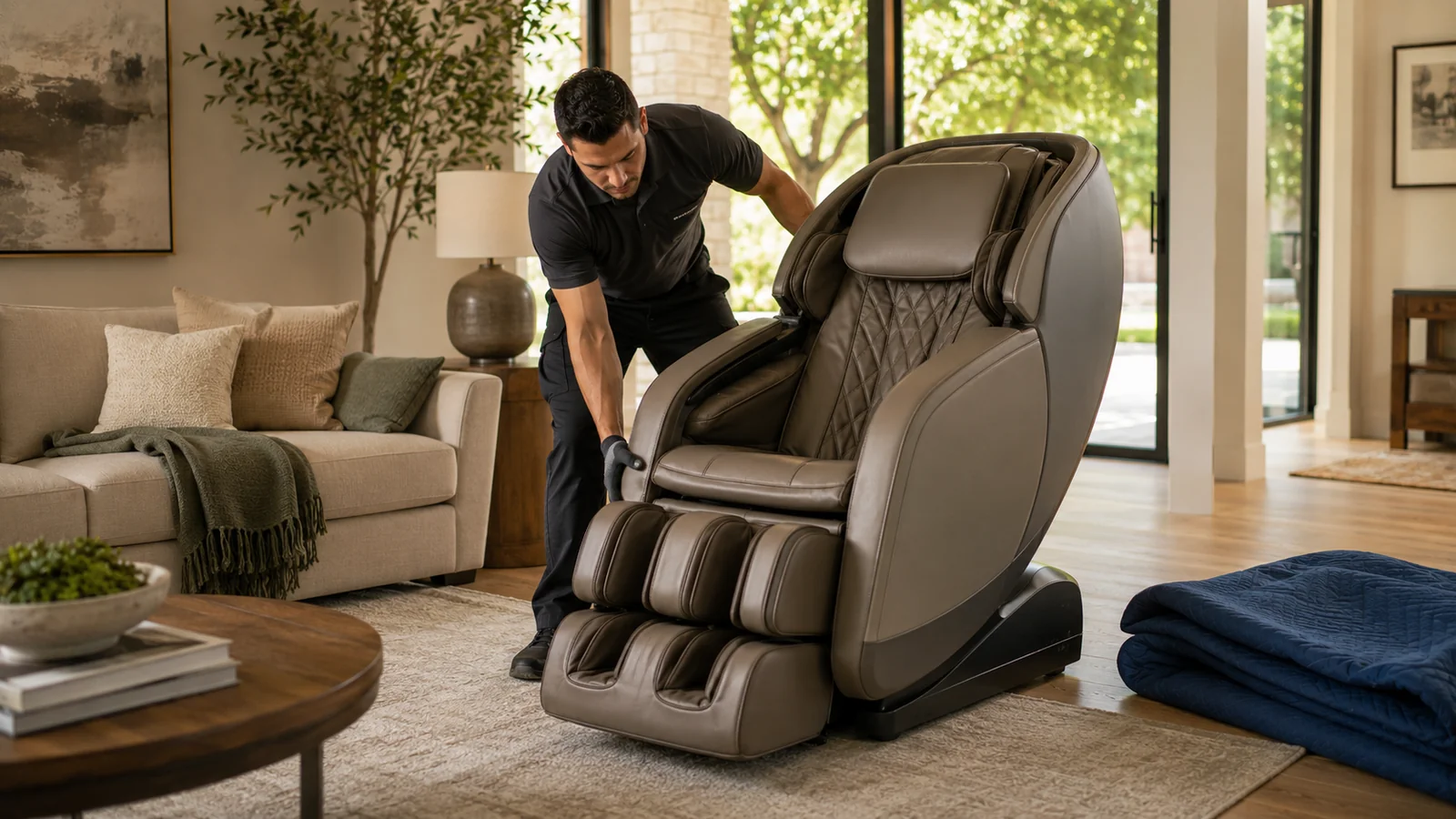
- What is the delivery cost?
- Is white-glove delivery available?
- Does delivery include placement in the room of your choice?
- What happens with stairs or narrow doorways?
- What room clearance does the chair need, including recline?
- What is the setup and assembly process?
- What happens if delivery fails or the chair will not fit?
- What are the return or cancellation terms?
Review quality and reputation
A star average rarely tells the whole story. Strong reviews are specific: they mention the showroom experience, staff guidance, delivery, warranty and service — not just “great chair.” Read for patterns across more than one independent source, favor recent and detailed accounts, and notice whether the seller responds constructively to problems. Repeated complaints about the same issue matter; a wall of generic five-star blurbs is less useful than a handful of honest, detailed ones.
- Product reviewsHow the chair itself feels and performs day to day.
- Retailer reviewsHow the seller communicates, prices and handles problems.
- Delivery & service reviewsHow delivery, setup and after-sale support actually went.
Pricing and financing transparency
Price matters, but total ownership cost matters more. Delivery, installation, warranty and service all change what a chair really costs over time, so compare retailers at similar service levels rather than on sticker price alone. Financing terms should be stated clearly — rate, length and total — not buried. A discount is not a substitute for a real explanation of what you are buying and what happens after delivery.
Price-focused vs trust-focused retailer
The same chair can come with very different ownership experiences. This is a way to think about the trade-off — not a rating of any seller.
| What to compare | Price-focused signals | Trust-focused signals |
|---|---|---|
| Warranty | Headline length, few details | Written terms for parts, labor and frame |
| Service | Unclear who repairs the chair | A named, reachable repair path |
| Delivery | Curbside drop, setup unclear | White-glove options explained up front |
| Claims | Bold health-sounding promises | Comfort and relaxation language |
| Reviews | Star average, few specifics | Recent, detailed service feedback |
| Pressure | Countdown urgency, “today only” | Room to decide, no rush |
| Post-purchase support | Hard to reach after the sale | Reachable, with clear next steps |
Lower price can be perfectly fair — the point is to compare like for like, including the support that comes after delivery.
Responsible wellness and medical claim language
How a retailer talks about health is itself a trust signal. There is a meaningful difference between describing comfort and making a medical-sounding claim, and a careful seller stays on the right side of that line.
Read the words, calmly
Comfort and relaxation are reasonable things to evaluate. Specific health-sounding promises deserve more scrutiny — it is fair to ask what evidence supports a claim before relying on it. Claims around chronic pain, circulation, neuropathy, arthritis, recovery or disease call for particular caution.
“Designed for comfort and relaxation; may offer temporary relief of minor muscle tension.”
Modest, honestly worded — reasonable to consider for comfort.Wording that implies a chair treats a condition, or phrases like “clinically proven,” “doctor recommended” or “guaranteed relief.”
Worth pausing on — ask what evidence supports it before relying on it.Massage chairs should be evaluated for comfort, relaxation, pressure preference, body fit, and temporary relief of minor muscle tension. They should not be treated as a substitute for medical diagnosis or treatment. For any diagnosed condition, consult a qualified healthcare professional.
This section is general consumer education, not medical advice.
Online retailer vs showroom retailer
Neither route is automatically better — they trade off differently, and both can be excellent when the seller is transparent. What matters is matching the channel to how confident you can be about fit and terms.
An online retailer can be strong if
- Policies are clear and easy to find
- Warranty support is clearly explained
- Delivery terms are transparent
- The return policy is understandable
- Reviews are recent and meaningful
A showroom retailer can be strong if
- Try-before-buy is genuinely available
- Staff explain real differences, not just upsell
- Warranty, service and delivery are clear
- You are not pressured to decide
- Current model availability is transparent
| Consideration | Showroom retailer | Online retailer |
|---|---|---|
| Comfort & body fit | Test in person before deciding | Judged from specs, photos and reviews |
| Selection | Limited to floor models on hand | Often a wider range of models |
| Convenience | Requires a visit | Shop from home on your schedule |
| Trying before buying | Direct hands-on testing | Depends on the return window |
| Delivery & setup | Often arranged in person | Confirm whether setup is included |
| If something goes wrong | Talk to staff directly | Relies on remote support and policy |
Red flags when choosing a retailer
None of these is proof of bad intent — treat each as a prompt to slow down and ask more before you commit. A trustworthy seller will welcome the questions.
- Vague warrantyCoverage described loosely or only verbally, never in writing.
- No service pathNo clear answer on who repairs the chair or how.
- Unclear deliveryCosts, scope and setup left undefined.
- Pressure-heavy urgencyCountdown timers and “today only” tactics.
- Fake-looking discountsPermanent “sales” with no real reference price.
- No written policiesReturns and cancellation you cannot read in advance.
- Medical treatment claimsPromises to treat, cure or fix a condition.
- Inconsistent identityName, address or details that do not match across sources.
- Generic reviewsOnly short, vague five-star posts with no specifics.
- No post-purchase supportHard to reach a person once the sale is done.
Retailer Trust Score criteria
You can turn the checks above into a simple, repeatable way to compare sellers. This is a framework for your own judgment — we do not assign scores to specific retailers, rank them, or use star ratings or awards.
- Retailer Trust Score
- A consistent set of criteria a buyer can apply to any seller to compare ownership confidence — not a published rating of any particular store.
- Showroom or buying accessCan you understand and reach the way you buy?
- Try-before-buyIn-person testing, or a clear return window.
- Warranty clarityWritten, specific, available before purchase.
- Service supportA named, reachable repair path.
- Delivery transparencyCost, scope and setup explained up front.
- Review qualityRecent, specific, across more than one source.
- Pricing & financing transparencyA written total and clear terms.
- Claim safetyComfort language, not medical promises.
- Business consistencyA stable, verifiable identity.
- Post-purchase supportReachable help after delivery.
Questions to ask before buying
Bring these massage chair buying questions to any showroom visit or seller conversation. Clear, confident answers are a good sign; hesitation on the basics is worth noting. Tick the ones you have a solid answer to.
Kept on this device only — no account, no email.
How we evaluate retailer trust
We are an independent guide, not a retailer — we do not sell massage chairs, rank sellers, or take payment to feature anyone. When we describe what makes a retailer trustworthy, we look at the same fronts we ask you to: showroom or buying access, business transparency, review quality, warranty and service clarity, delivery and installation clarity, pricing and financing transparency, responsible claim language, and clear disclosure. Where our standards or methods are relevant, we link to them in the open so you can check our work.
Editorial standards
How we decide what to publish, and the line we hold between guidance and selling.
Showroom verification methodology
The criteria we use to describe what makes a showroom worth visiting.
Disclosure
How we stay independent, and how the site is funded and operated.
Medical disclaimer
Why we treat health and wellness claims cautiously, and where to get medical advice.
Looking for local showroom guidance?
If you are shopping near you, our regional guides explain what to look for in a massage chair showroom and how to evaluate one before you go. They are guidance, not a directory of specific stores, and not places we operate or endorse. The same questions apply wherever you live: can you actually test the chairs, is warranty and service information clear, and are the people knowledgeable and transparent?
California showroom guidance
Statewide guidance on what makes a showroom worth a visit and how to compare options before you go.
California massage chair showroom guidanceBay Area showroom guidance
A closer look at evaluating showrooms across the Bay Area, using the same neutral checklist you would apply anywhere.
Bay Area massage chair showroom guidanceThese guides can help whether you are shopping near San Jose, Santa Clara, Valley Fair, Oakridge, Walnut Creek or Sacramento — areas where readers commonly shop, not stores we endorse. Searching for a massage chair store near me or a massage chair dealer near me? Use the same questions to compare any one before you visit.
Comparing brands through a retailer?
A good retailer should help you compare brands and models fairly — by fit, comfort, warranty, service, delivery and responsible claim language — rather than steering you toward whatever it most wants to sell. A brand name alone will not tell you whether a particular chair suits your body or your space, and a seller is not trustworthy simply because it carries a certain brand. We do not rank brands, and we do not imply every brand or model has been tested.
Examples you can evaluate with the same retailer checklist
The checks above work best when you apply them to a real seller. Two California multi-brand retailers publish enough public information — showroom pages, brand pages, current product listings, and delivery and warranty messaging — that you can practise running the whole checklist before you ever call them. They are included here as examples to evaluate, not as a ranking, and each carries a different brand line-up, so treat the exercise as a way to test the process rather than a recommendation of one over the other. Whatever a public page says, confirm the exact terms in writing before you pay.
Note: Massage Chairs & More and House of Massage Chairs are included as public showroom examples to verify, not rankings or endorsements — confirm current models, warranty, delivery and service directly.
Massage Chairs & More
Public California showroom example
Publishes showroom pages for Santa Clara (South Bay), Pleasanton (East Bay), Daly City (Peninsula) and the Sacramento region, and currently lists Panasonic, OHCO, D.Core, Koyo and Positive Posture — enough public detail to test business identity, current availability and written-terms messaging against the checklist.
Confirm before visiting:
- Which exact models are on the floor today
- Warranty provider, parts and labor terms in writing
- Delivery level, installation and packaging removal
- Return, restocking and cancellation terms
House of Massage Chairs
Public Bay Area showroom example
Publishes store pages for the Bay Area and a multi-brand floor that currently includes Osaki, Infinity, Kyota, Ogawa, Cozzia, Bodyfriend and Fujiiryoki, alongside delivery and manufacturer-warranty messaging you can hold up against the checklist’s service, delivery and claim-language rows.
Confirm before visiting:
- Which exact models are on the floor today
- Manufacturer warranty coverage in writing
- White-glove delivery and in-home setup details
- Return, restocking and cancellation terms
A polished website or large showroom does not replace written purchase terms. Confirm the warranty, service path, delivery level, return policy and exact chair condition before paying.
For more on this, weigh where to buy a massage chair , check what makes a massage chair showroom legitimate , and review the full warranty, delivery and service guide .
Frequently asked questions
How do I choose a massage chair retailer?
Start by judging the seller as carefully as the chair. Confirm a clear business identity, showroom or try-before-buy access where possible, written warranty terms, a named service and repair path, transparent delivery and return policies, meaningful reviews, honest pricing, and responsible claim language. A trustworthy retailer answers these readily and never pressures you to decide before you are ready.
What makes a massage chair retailer trustworthy?
Trust shows up as consistent, observable behavior: a verifiable business identity, written policies you can read in advance, clear warranty and service terms, transparent delivery and pricing, comfort-focused rather than medical-sounding claims, and recent, specific reviews across more than one source. A trustworthy retailer stays reachable after the sale and gives you room to decide without pressure.
What is the best place to buy a massage chair?
There is no single best place to buy a massage chair. The right choice depends on whether you can test the model you want, how clear the warranty, service and return terms are, and how transparent the seller is. A showroom suits buyers who value testing fit in person; a well-run online retailer suits those who value range and convenience with strong return terms.
Should I buy from a showroom or online?
Both can work; they trade off differently. A showroom lets you test comfort, body fit and pressure preference before you commit. Buying online can offer convenience and a wider selection, but you rely on photos, reviews and the return policy. Whichever you choose, confirm warranty, service, delivery and return terms in writing — the questions that protect a high-ticket purchase stay the same.
What questions should I ask a massage chair dealer?
Ask whether you can test the chair, who handles warranty and who handles service, what delivery includes, and what happens if the chair does not fit your space. Confirm the return or cancellation policy, whether any financing terms are clear, whether claims are comfort-based or medical, whether the model is currently available, and whether you can take time to decide.
How do I verify an authorized massage chair dealer?
Check the retailer’s stated business name, address and contact details, and look for a consistent identity across its website and Google Business Profile. If a seller claims authorized-dealer status for a brand, ask for confirmation you can verify with the manufacturer. Treat authorized status as one signal among many — not proof on its own — and never assume it without clear evidence.
Are Google reviews enough to trust a retailer?
Google reviews help, but a star average alone is not enough. Read recent, specific reviews that describe the showroom experience, staff guidance, delivery, warranty and service — not just a wall of short five-star posts. Look for patterns across more than one independent source, and notice whether the seller responds constructively to problems rather than ignoring them.
What are red flags when buying a massage chair?
Common red flags include vague or verbal-only warranty terms, no clear service or repair path, unclear delivery, pressure-heavy urgency, fake-looking discounts, missing written policies, medical treatment claims, an inconsistent business identity, only generic reviews, and no reachable support after the sale. Treat each one as a prompt to ask more questions rather than proof of bad intent.
What warranty and service questions should I ask?
Ask what the warranty covers and for how long — parts, labor, electronics and frame are often different — and whether in-home service is included. Confirm who actually performs repairs (the retailer, the manufacturer or a third party), how a claim is requested, how long service may take, and what is excluded. The terms should be written clearly, not promised verbally.
What medical claims should a retailer avoid?
A trustworthy retailer describes comfort, relaxation and the temporary relief of minor muscle tension, and avoids treatment or cure claims. Be cautious with wording that implies a chair treats a condition or uses phrases like clinically proven, doctor recommended or guaranteed relief. Ask what evidence supports any health-sounding claim, and consult a healthcare professional for any diagnosed condition.
Before you buy
Compare retailer transparency before you buy
Choose the seller with the same care you choose the chair. A clear, honest, reachable retailer is what makes ownership calm for years to come.
Independent guidance — we don’t sell massage chairs, rank retailers, or take payment to feature anyone.
Last updated: July 2026 · Editorial standards · Disclosure