Short answer
MassageChairsTested.com creates consumer-first massage chair guides using criteria-based comparisons, careful review interpretation, showroom verification standards, and warranty, service and delivery checks — with deliberate caution around medical-sounding claims. These editorial standards exist to help you reduce decision risk, not to push a brand, retailer, or product. We sell nothing, and no one can pay to be featured, ranked, or recommended.
Our framework at a glance
- Consumer firstBuyer safety and clarity over sales pressure.
- Criteria-basedWe compare on stated criteria, never hype.
- Evidence awareSignals and patterns, labelled for what they are.
- Claim-safeComfort-and-relaxation language, not medical promises.
- No fake rankingsNo “best” leaderboards, star scores, or awards.
- Updated over timeWe revise pages and correct errors openly.
- Transparent limitsWe say plainly what we cannot verify for you.
- Methodology linkedEvery standard ties back to a detailed method.
Key takeaways
- We publish guidance, not products — there is nothing to add to a cart here.
- Coverage and placement cannot be bought, and we never rank brands or retailers.
- We compare by criteria, separate product from retailer and delivery signals, and read reviews for patterns.
- Health language stays cautious: comfort and relaxation, never diagnosis or treatment.
- We show our limitations, date our pages, and fix mistakes in the open.
Key terms
- Editorial standards
- The documented rules we hold ourselves to when we choose topics, write, compare, source claims, disclose interests, and update pages.
- Review methodology
- How we approach reviews and comparisons — describing characteristics rather than ranking, and separating product, retailer, and delivery signals.
- Showroom verification
- The observable criteria we use to describe what makes a showroom worth visiting, plus an honest account of what only your own visit can confirm.
- Claim safety
- Holding wellness language to a calm standard: comfort, relaxation, and temporary relief of minor muscle tension — never diagnosis, cure, or treatment.
- Disclosure
- A plain statement of how this guide is funded and operated, and the lines we hold to stay independent.
- Correction policy
- How we fix genuine errors in the open and update pages when information changes, rather than editing quietly.
- Content freshness
- Keeping pages current with a visible “last updated” date, because models, terms, and availability change over time.
- Criteria-based comparison
- Comparing chairs, retailers, or showrooms against the same practical criteria instead of declaring a single “best.”
Our editorial promise
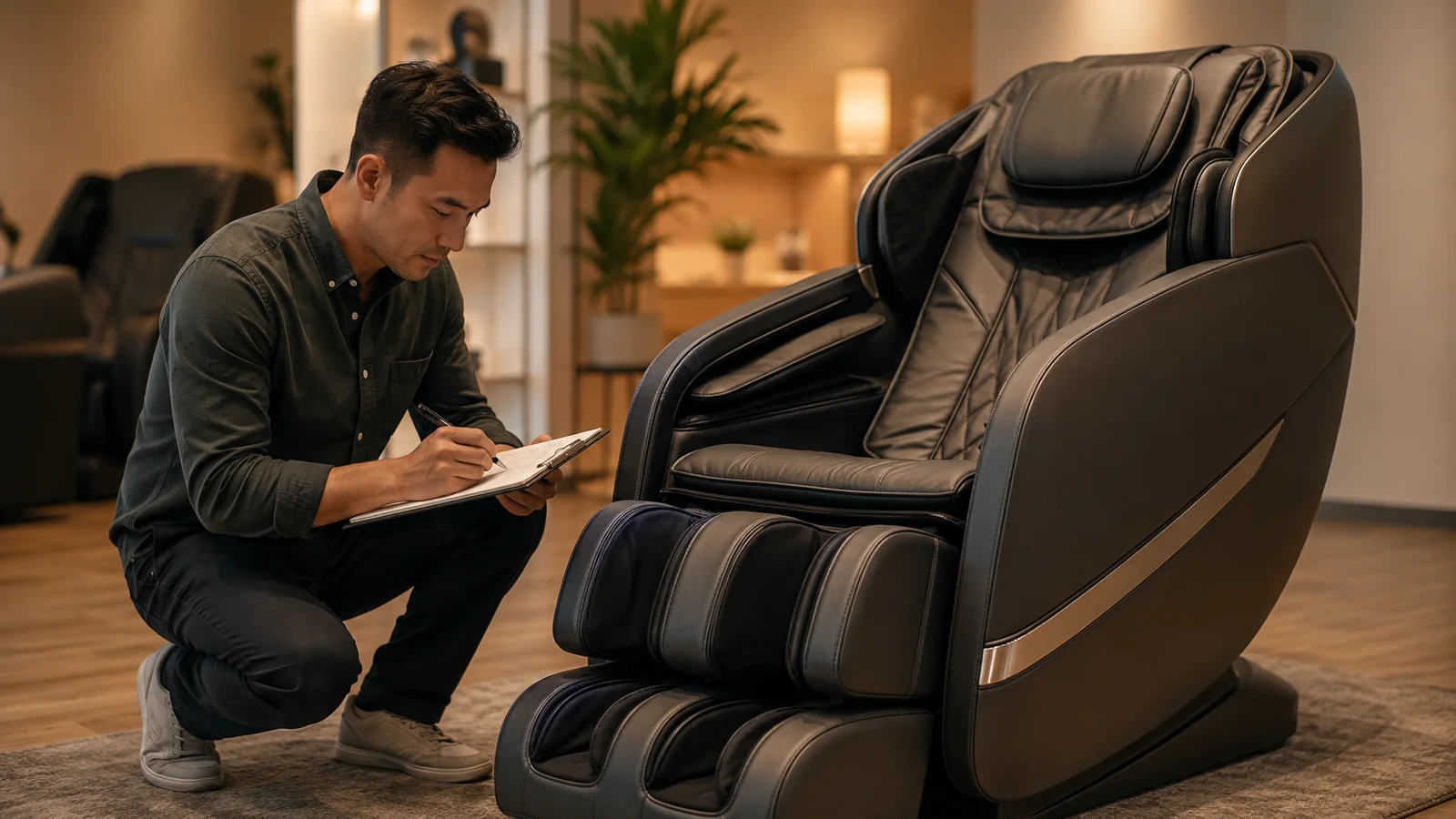
This page is about us. It sets out the standards that keep what you read here useful, honest, and free of the pressure you often feel in a store. The promise underneath all of them is simple: we work for the reader, not for a sale. If anything on this site ever reads like a pitch, treat that as our mistake, not our intent.
In practice, that promise means:
- Consumer-first guidance. We optimise for your decision, not a transaction — reducing buyer risk matters more than persuasion.
- No fake rankings. No “best chair” leaderboards, no star scores, and no invented awards or certifications.
- No universal “best” without criteria. Where we compare, we say on what basis; the right chair depends on your body, budget, and space.
- No hard sales pressure. No countdown timers, “limited stock,” or pushy calls to action.
- No unsupported medical claims. We describe comfort and relaxation, never treatment or cure.
- No hidden retailer content. We don’t quietly promote a store or dress a sales page up as editorial.
- Clear limitations. We tell you what we can’t verify, so you know where your own judgement takes over.
What we are — and what we are not
The clearest way to understand our standards is to see both sides of them at once. This isn’t a defensive list; it’s the boundary that makes consumer-first guidance possible in a category crowded with sales pages.
- A consumer-education platform
- A buying-decision guide
- A showroom-aware resource
- A criteria-based comparison site
- A review-interpretation resource
- A claim-safety resource
- A retailer-owned sales page
- An affiliate ranking farm
- A medical-advice site
- A competitor-attack site
- A fake-review platform
- A discount-shopping site
Where any commercial relationship or funding source exists, we describe it plainly on our independence and disclosure statement . We don’t overpromise, either: we won’t tell you we’re “guaranteed unbiased” or the only honest source. We simply hold these lines and show our work, so you can judge the result for yourself.
How we build buyer guides
Every guide starts from a real shopper question, not a keyword. Before we write, we define the buyer problem, map the search intent behind it, and ask where the real decision risk sits — because a massage chair is a major purchase you can’t judge from a photo.
Consumer-first content standards
From there, each guide follows the same discipline:
- Separate the questions that get blurred. Product, retailer, delivery, warranty, and service are different decisions; we keep them apart so one good experience can’t mask another’s risk.
- Make it usable. We include checklists you can act on, and we state the limitations of the advice rather than implying it covers everything.
- Link to depth. We summarise here and point to fuller guides, instead of repeating or overstuffing a single page.
- Write for humans first. Plain English, explained jargon, and trade-offs over verdicts — search engines come second.
You can see the standard in action in our massage chair buying checklist , our take on buying online versus in a showroom , and the warranty, delivery and service guide .
How we handle reviews
Reviews are useful but easy to misread, so our standard for review interpretation is consistent: treat them as signals, not proof. A single star average flattens hundreds of different experiences, and the loudest voices — delighted or furious — rise to the top. We read for what many independent people mention without prompting.
- Product reviewsHow the chair feels, fits, sounds and holds up over time.
- Retailer reviewsHow the seller communicates, prices, and stands behind the sale.
- Delivery & service reviewsHow delivery, installation and later repairs actually went.
From that, our review standards follow plainly: we separate the three kinds of feedback above, favour recent and detailed accounts, watch for repeated patterns, and avoid fake star-rating displays or unsupported “best” conclusions. We never treat a review as medical evidence. The full reasoning lives in our review methodology , and the shopper-facing version is our guide to reading massage chair reviews without being misled .
How we evaluate showrooms and retailers
We describe what tends to make a showroom or retailer worth your time, using observable trust signals rather than reputation or ranking. We don’t operate, score, or endorse any store. Our showroom verification standard looks at the same practical signals every time:
- Showroom transparency and try-before-buy access — can you test the exact model, unhurried and without pressure?
- Business verification — a clear identity, address, and contact details you can confirm.
- Warranty clarity and service support — coverage, repairs, and who actually handles them, in writing.
- Delivery and installation transparency — white-glove versus curbside, setup, and packaging removal spelled out.
- Review quality and responsible claim language — honest comfort-and-relaxation wording, not disease promises.
Because showroom conditions change, we frame these as things you can confirm in person, and we’re open about where our visibility ends. See our showroom verification methodology , what makes a massage chair showroom legitimate , and how to choose a massage chair retailer .
How we handle medical-sounding claims
Massage chairs are often marketed with wellness language, and our standard for claim safety is deliberately careful. Comfort and relaxation are not the same as treatment. Claims about disease, cure, circulation, neuropathy, arthritis, chronic pain, or recovery require caution — reviews are anecdotes, not medical proof, and showroom testing shows comfort, not medical outcomes.
“Designed for comfort and relaxation.”
“May offer temporary relief of minor muscle tension.”
“Pressure and intensity are a matter of personal preference.”
Describes feel and experience without promising an outcome.“Improves circulation” · “treats neuropathy or arthritis.”
“Clinically proven” · “doctor recommended” · “medical-grade.”
“Cures pain” · “guaranteed relief.”
Outcome and treatment claims we will not repeat as fact.Note
Massage chairs should be evaluated for comfort, relaxation, pressure preference, body fit, and temporary relief of minor muscle tension. They are not medical devices, and nothing on this site is medical advice or a substitute for diagnosis or treatment. If you have a diagnosed condition, are pregnant, or have any health concern, consult a qualified healthcare professional first. See our medical disclaimer .
How we handle brand and model comparisons
We compare brands and models by criteria, not hype, and we hold to brand neutrality throughout. A brand name alone isn’t enough information to decide anything — model-level details, and the warranty, service, delivery and retailer channel behind a chair, matter just as much as the badge on it.
- We avoid “best overall” verdicts unless a stated method genuinely supports them.
- We use no fake ratings, no fake rankings, and no price-driven “recommended” blocks.
- We treat every brand the same way, against the same practical criteria.
For a neutral, unranked starting point, see our overview of massage chair brands to know and compare before buying .
How we handle local showroom guides
Local pages are easy to abuse, so our local-page standard is strict. We write regional guidance to help you shop an area more confidently — not doorway pages, and not “near me” keyword stuffing.
- No fake local rankings and no fabricated “verified” locations.
- We separate state, regional, and city-level intent so each page is genuinely useful.
- Every local page carries buyer-useful criteria, not hidden store promotion.
You can see the standard in our California massage chair showroom guidance and Bay Area massage chair showroom guidance — both written as guidance, not a directory, and both grounded in our showroom verification methodology .
How we use keywords and AI search strategy
Keywords help us understand and structure what shoppers are actually trying to do; they don’t override usefulness. We don’t keyword-stuff, and we don’t let a search term bend a page away from honest guidance. Our test is simple: a page should be worth reading even if search engines didn’t exist.
Our AI answer standard works the same way. We write concise, safe, extractable answers and real FAQ entries because they help both people and the AI systems that increasingly summarise the web — but the underlying content has to earn that visibility on quality first. Clear structure, accurate sourcing, and stated limitations are how we pursue Google SEO quality and AI answer visibility together, consistent with E-E-A-T principles, without trading away trust.
Corrections, updates and limitations
Information in this category changes. Product, brand, and showroom availability shift; warranty and service terms get revised; and medical or regulatory language evolves. So content freshness is part of accuracy, not an afterthought.
- Pages carry a visible last updated date, and our methodology pages may be revised over time.
- When we identify a genuine error, we correct it in the open rather than quietly editing it away.
- We keep our limitations visible instead of implying certainty we don’t have.
We don’t promise perfect, permanent accuracy — no honest guide can. We promise to keep pages current and to fix what’s wrong. The full process lives in our correction policy , and if you spot something that looks off, we want to hear about it.
Our core editorial principles
If the sections above describe how we work, these ten principles are the short version — the trade-offs we make every time they come into tension.
Buyer safety over sales pressure
Your decision comes before any transaction.
Criteria over hype
Stated criteria, not adjectives, drive every comparison.
Transparency over hidden incentives
Anything that could shape coverage is disclosed.
Comfort and fit over specs alone
A spec sheet can’t tell you how a chair feels for you.
Warranty and service over price alone
What happens after delivery matters for years.
Evidence over medical-sounding claims
Comfort and relaxation, never diagnosis or cure.
Review patterns over star ratings alone
Many detailed voices beat a single average.
Local usefulness over doorway SEO
Regional pages must help, not just rank.
Limitations over exaggerated certainty
We’d rather state a limit than overclaim.
Methodology over fake authority
We link the method instead of asserting trust.
Strong editorial standard vs weak content pattern
The same principles, drawn as the contrast we try to stay on the right side of.
| Strong standard | Weak pattern |
|---|---|
| Criteria-based comparison | A fake “top 10” list with a pre-decided winner. |
| Review-pattern analysis | Star-rating worship that ignores the spread. |
| Claim caution | A medical promise the product can’t support. |
| Showroom verification | Hidden promotion of one store as “the” choice. |
| Written limitations | Exaggerated certainty that hides the unknowns. |
A checklist you can hold us to
These are the questions we ask of our own pages — and the same ones you can use to judge any massage chair guide, including this one. Tick what a guide actually does. Your ticks are saved on this device only, with no account and no email.
A consumer-first content-quality check you can apply to any source.
How we handle named retailers and showroom examples
Occasionally a guide names a real retailer or points to a public showroom page as a worked example — a way to show how the same buying criteria apply to information you can actually go and check. We only do this when it genuinely helps answer a specific buyer question, such as where a particular brand can be tried in person. Naming a retailer is never a reward, a ranking, or a verdict; it is an example to verify, and nothing more should be read into the fact that one appears on a page.
When we do reference a named retailer or showroom, we hold to the following:
- Relevance decides inclusion. A retailer is named only when it answers the reader’s actual question — not to fill space or because a relationship exists.
- Geography and brand availability can justify a mention. Where you live and which brands a store publicly carries are practical reasons an example earns a place; they are not a claim that it is the only or the best option.
- We check the public page before publishing. We read the retailer’s own live pages and describe what they show, rather than relying on memory or another site’s summary.
- We qualify marketing language instead of repeating it. A store’s own promotional wording — “widest selection,” “guaranteed,” “best price” — is described as the retailer’s claim, not restated by us as fact.
- Changing facts get call-ahead wording. Inventory, floor models, hours, pricing, warranty, delivery and service shift, so we tell you to confirm them directly and verify the details in writing before you visit.
- No paid placement. No retailer can pay to be featured, ranked or rated; any commercial relationship or funding source that ever applies is disclosed on the independence and disclosure statement .
- No retailer can buy a favorable score. No payment, relationship, or advertising spend can purchase inclusion, a better description, or any editorial conclusion.
- No store is called universally best. We never describe a retailer as the top choice, the recommended dealer, or the one place to buy; the right seller depends on your needs.
- No invented ratings. We attach no star scores, badges, or awards to any retailer, and we don’t manufacture rankings from thin air.
- Inclusion is not a ranking. The order or presence of a named example implies no league table — treat every mention as a starting point to check for yourself.
This is simply our brand-neutral standard applied to real stores. For the fuller picture, see how we describe chairs rather than rank them in our review methodology , how we verify what a store publishes in our showroom verification methodology , and how we fix anything that turns out to be wrong in our correction policy .
Frequently asked questions
What are MassageChairsTested.com’s editorial standards?
They are the documented rules behind our consumer-first massage chair guides: how we choose topics, write plainly, compare by criteria, source claims, handle medical-sounding language, disclose interests, and correct mistakes. The goal is to reduce your decision risk rather than push a product. We sell nothing, rank no one, and link every standard to a more detailed methodology.
Is MassageChairsTested.com independent?
Yes. We do not sell massage chairs, run a showroom, or take payment to feature, rank, or rate any brand or retailer, and no outside party approves our wording. We won’t claim to be “guaranteed unbiased” — instead we hold clear lines, show our reasoning, and disclose any commercial relationship so you can judge for yourself.
Does MassageChairsTested.com rank products or retailers?
No. We don’t publish “best chair” lists, star scores, leaderboards, or awards, and we never name a single recommended store. Comfort and fit are personal, so a ranking would mislead. Instead we compare by the same practical criteria — fit, warranty, service, delivery, reviews, and claim language — and let you weigh them against your own needs.
How does MassageChairsTested.com evaluate reviews?
We treat reviews as signals, not proof. We separate feedback about the product from feedback about the retailer and about delivery and service, then look for patterns repeated across recent, detailed accounts. We avoid star-rating worship and never present review anecdotes as medical evidence. No review can confirm a chair will fit your body — only sitting in one can.
How does MassageChairsTested.com evaluate showrooms?
We describe observable trust signals: unhurried testing access, warranty clarity, service transparency, honest delivery terms, knowledgeable staff, and responsible claim language. We don’t operate, score, or endorse any store, and we publish no “verified” location lists. Because showrooms change, we frame our criteria as things you can confirm in person, and explain where our visibility ends.
How does MassageChairsTested.com handle medical claims?
Cautiously. We describe comfort, relaxation, and temporary relief of minor muscle tension, and we treat disease, cure, circulation, or condition-specific claims as language that needs caution, not facts to repeat. A massage chair is not a medical device, and nothing here is medical advice. For any diagnosed condition or health concern, consult a qualified healthcare professional.
Does MassageChairsTested.com use affiliate links?
Our guidance is not built around affiliate-style rankings or “buy now” buttons, and payment can never buy coverage, placement, or a conclusion. There is nothing to purchase here. If any funding source or commercial relationship exists, we describe it plainly on our disclosure page so the basis for our independence is visible.
How often are pages updated?
We revise pages when information changes and show a visible “last updated” date on each one. Models, brand availability, warranty terms, delivery options, and regulatory language all shift over time, so freshness is part of accuracy. We don’t promise permanent accuracy — we promise to keep pages current and to flag what may have changed.
How are corrections handled?
Openly. When we identify a genuine error, we fix it in the open rather than quietly editing it away, and we update the page when facts change. If you spot something that looks wrong, we want to know. Our correction policy explains how we review, fix, and note changes so you can trust what you read here.
Why should buyers trust MassageChairsTested.com?
Because our incentives are visible and our limits are stated. We sell nothing, rank no one, and can’t be paid for a conclusion; we compare by criteria, read reviews for patterns, keep health language cautious, and link every standard to a detailed method. We’d rather show our reasoning and our limitations than ask you to trust us blindly.
Explore our trust pages
Each standard above connects to a deeper page. Start with the methodology behind our reviews and showroom criteria, then see how we stay independent and how we treat health language.
Review methodology
How we describe chairs rather than rank them, and separate product from retailer and delivery signals.
Showroom verification methodology
The observable criteria we use to describe a worthwhile showroom — and the limits of what we can verify.
Disclosure
How this guide is funded and operated, and the lines we hold to stay editorially independent.
Medical disclaimer
Why we treat health and wellness language cautiously, and when to consult a professional.
How To Use Our Guides
Use our guides as decision support, not sales pressure
Take your time, compare on your own terms, and lean on the methodology behind every page. When you’re ready, start with how we evaluate chairs and showrooms.
Last updated: July 2026 · Editorial standards · Disclosure