Last updated: June 2026 · Independent guide · We don't sell chairs, run showrooms, or rank stores
Short answer
MassageChairsTested.com evaluates massage chair showrooms by looking at showroom presence, try-before-buy access, brand and model comparison, review quality, warranty and service clarity, delivery and installation transparency, pricing and financing transparency, and responsible claim language — all in service of reducing buyer risk. Our showroom verification methodology is designed to compare standards and help you ask better questions. It does not create fake rankings, display verified badges, or guarantee outcomes.
Methodology, not certification
This methodology is a consumer decision framework — not an official certification, a paid endorsement, or a guarantee. Buyers should still verify current hours, model availability, warranty terms, service support and delivery details directly with a showroom before visiting or buying.
Showroom verification framework
Eight things we look at when we evaluate a showroom
No single category decides anything. We weigh these together as a framework you can apply yourself — not as a score or rating of any specific retailer.
- Showroom presenceA verifiable, visitable location and consistent identity.
- Try-before-buyGenuine in-person testing, not a 60-second demo.
- Brand/model comparisonReal choice, with differences explained honestly.
- Review qualityDetailed, recent feedback with owner responses.
- Warranty clarityWritten terms, with parts and labor explained.
- Service supportA clear path to repairs and who performs them.
- Delivery transparencyIn-home setup vs. curbside stated before you pay.
- Claim safetyComfort and relaxation language, not medical promises.
An editorial framework for comparing showrooms — not a score, rating, or ranking of any retailer.
This page explains how we evaluate massage chair showrooms: the criteria behind our showroom guides, retailer checklists and local pages, and — just as importantly — the limits of what any third party can confirm from the outside. It is a buyer-first standard you can carry into any store, online or in person. It is not a directory, a ranking, or an endorsement of any specific business.
- Showroom verification
- Checking a showroom against consistent, public criteria — presence, testing access, reviews, warranty, service, delivery and claim language — rather than trusting marketing or a single star rating.
- Showroom transparency
- How openly a showroom shares the things that shape your purchase: its identity, pricing and financing, warranty and service terms, delivery details, and what it can and can't promise about health.
What this methodology is and is not
Before the criteria, it helps to be clear about scope. We hold this line deliberately, because a methodology that promises more than it can deliver is its own kind of red flag.
This methodology is
- A framework for evaluating showroom quality.
- A buyer-risk reduction tool.
- A way to compare showroom standards consistently.
- A support system for our local and showroom guides.
- A transparency framework you can apply yourself.
This methodology is not
- A paid endorsement system.
- An official certification or accreditation.
- A guarantee of buyer satisfaction.
- A medical evaluation of any kind.
- A ranking unless criteria and evidence are visible.
- A replacement for verifying details before you visit.
In other words, we describe and structure the criteria; the verification that decides your purchase is the one you perform in person. For a fuller view of the lines we hold across the whole site, see our editorial standards and how we approach reviews and comparisons .
Why showroom verification matters
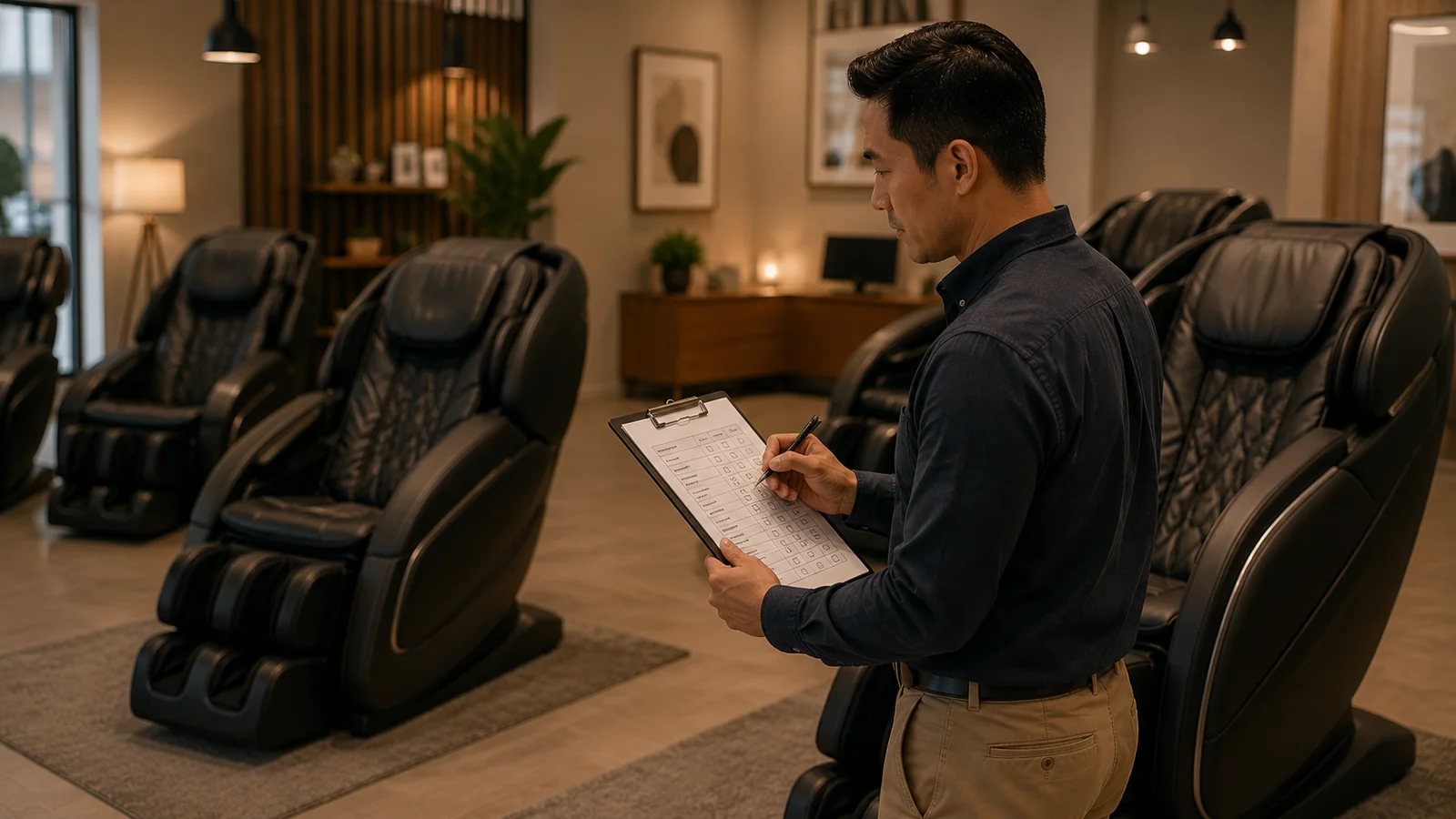
A massage chair is a high-ticket, fit-sensitive purchase you may rely on for years, and the seller often handles your warranty, service and delivery long after the sale. That makes who you buy from matter as much as which chair you choose. Clear showroom standards lower your uncertainty instead of manufacturing pressure.
- Massage chairs are high-ticket and fit-sensitive. Height, build and pressure preference change how a chair feels, so the buying process deserves care.
- Try-before-buy can reduce regret. Sitting a full program tells you what a spec sheet or photo can't.
- The showroom experience shapes decision quality. A calm, transparent floor helps you compare; a pressure-first one rushes you.
- Warranty, service and delivery clarity affect ownership risk. Vague answers here become expensive surprises later.
- Reviews and Google profiles need context. A star average hides the detail that actually predicts your experience.
- Unsupported claims can mislead. Treatment-style promises are a reason to slow down, not speed up.
- Standards help you ask better questions. Knowing what "good" looks like turns a visit into a confident comparison.
None of this means a physical showroom is always the right choice — plenty of buyers do well shopping carefully online with a clear return window. The point is that the same signals apply either way. (For the trade-offs, see buying online vs. in a showroom .)
Core showroom evaluation categories
When we describe what makes a showroom worth visiting, we look at the same ten categories every time and apply them consistently. Each one is something you can observe and confirm yourself — that's the point.
- Physical showroom presenceA real, verifiable location with a consistent business identity.
- Try-before-buy accessGenuine in-person testing across more than one model.
- Brand and model comparisonMeaningful choice, with differences explained — not hyped.
- Staff guidance and transparencyNo-pressure help that answers specific questions honestly.
- Review qualityDetailed, recent reviews — not just a star average.
- Warranty clarityWritten coverage, with parts, labor and exclusions explained.
- Service supportA clear repair path and who actually does the work.
- Delivery and installation transparencySetup vs. curbside, stairs and room fit, stated up front.
- Pricing and financing clarityPrices and any financing terms explained without games.
- Responsible claim languageComfort and relaxation, not promises to treat or cure.
For each category we ask the same three questions: what it means, why it matters, and what a buyer should verify. The sections below work through the categories that carry the most weight. They map closely to our buyer-facing guide on what makes a massage chair showroom legitimate and our retailer transparency checklist .
- Retailer transparency
- How openly a seller shares pricing, financing, warranty, service and claim information across its website, listings and in-store conversations — a strong predictor of the experience after you pay.
Showroom verification checklist
Use this massage chair showroom checklist as you research a store or plan a visit. Tick what you can confirm — it's a private thinking tool, not a sign-up, and nothing is saved to our servers or sent anywhere.
Tick what you can verify as you research — it's a private checklist, not a sign-up. Nothing is saved or sent.
Suggested showroom trust score framework
To compare showrooms consistently, it helps to weight the categories rather than treat them as equal. Below is a transparent 100-point framework. We publish the weights openly so you can see exactly what counts and apply the same logic yourself. We do not display a numeric score for any specific store on this page.
- Showroom trust score
- A transparent way to weight showroom criteria so the things that most affect buyer risk — testing access, warranty, service and delivery — count for more than the things that affect it less. A score is only meaningful alongside visible criteria, evidence and limitations.
| Evaluation category | Weight | What earns the points |
|---|---|---|
| Try-before-buy access | 15 points | Genuine in-person testing across multiple models, with time and freedom to adjust settings. |
| Physical showroom presence | 10 points | A verifiable location, consistent identity, and real photos of the space where available. |
| Brand/model comparison | 10 points | Meaningful choice with differences explained honestly across comparable tiers. |
| Staff guidance and transparency | 10 points | Specific, no-pressure answers and willingness to put terms in writing. |
| Review quality and reputation signals | 10 points | Recent, detailed reviews about the visit, delivery and service — with owner responses. |
| Warranty clarity | 10 points | Written coverage with parts, labor, length and exclusions explained plainly. |
| Service support | 10 points | A clear repair process, named responsibility, and realistic turnaround. |
| Delivery/installation transparency | 10 points | In-home setup vs. curbside, stairs, room fit and return terms stated before purchase. |
| Responsible claim language | 10 points | Comfort and relaxation framing, with no treatment-style or disease claims. |
| Pricing/financing transparency | 5 points | Clear prices and financing terms, with no hidden conditions or pressure. |
How a score should — and shouldn't — be used
A score should never be presented as a ranking without visible criteria, evidence, context and clear limitations. It reflects how well a showroom's standards are documented, not whether you'll be satisfied. This framework is a decision aid, and it may evolve as better verification standards develop.
Criteria-based evaluation vs. a fake ranking
The difference between a useful framework and marketing dressed up as a rating comes down to whether you can see the work.
| Aspect | Criteria-based evaluation | Fake ranking |
|---|---|---|
| Criteria | Published and consistent | Hidden or undefined |
| Evidence | Shown and checkable | Asserted, not shown |
| Incentives | Disclosed; no pay-to-rank | Often paid placement |
| Limits | Stated openly | Implied as certainty |
| Best used for | Asking better questions | Steering a quick sale |
Physical showroom presence
What it means: a real, accountable business you could actually visit. Why it matters: a verifiable presence is the foundation everything else rests on. What to verify: most of it from home, in a few minutes.
- Real location — a mappable address you could drive to.
- Clear, consistent business name across the website, contact page and listings.
- A maintained Google Business Profile with matching name, address and hours.
- Current hours posted and accurate.
- Real showroom photos of the space and chairs where available, not stock imagery alone.
- Appointment or walk-in clarity so you know how to plan a visit.
- Model availability you can confirm before making the trip.
- A clear contact path — a working phone number and a reachable contact page.
A note on "verified"
We don't claim every showroom has been physically inspected, and we don't display verified badges. Presence is something you confirm — a real address, consistent details and a reachable contact — not something a badge can prove for you.
Try-before-buy access
What it means: the chance to sit in chairs the way you actually would at home. Why it matters: comfort, body fit and pressure preference are personal, so this is the single most useful thing a showroom offers — which is why it carries the most weight in the framework. What to verify:
- Can you sit in the chairs, not just look at them?
- Can you test multiple models across price tiers?
- Can you compare pressure, body fit, controls, recline and foot/calf comfort?
- Is the demo no-pressure, or a rushed pitch at maximum intensity?
- Is enough time allowed — a full program, often 15 minutes or more?
- Can more than one decision-maker try the chair on the same visit?
- Try-before-buy access
- The ability to genuinely test a chair in person — sitting a full program, adjusting settings, and comparing models — before committing. A showroom that explains demo availability plainly is easier to trust than one that rushes it.
Brand and model comparison
What it means: whether a showroom helps you weigh real options. Why it matters: comfort is personal, so being able to compare side by side is genuinely useful. What to verify: the quality of the comparison, not the number of logos.
- Multi-brand or multi-model access can help you compare, but a transparent single-brand showroom can be perfectly legitimate too.
- Exact model availability matters — a brand name on the wall isn't the same as the model on the floor.
- Brand name alone isn't enough; judge fit, warranty, service and delivery.
- Staff should explain differences without overclaiming or defaulting to a feature recital.
- Compare similar price and feature tiers so you're weighing like for like.
- Confirm availability before visiting so the trip is worth it.
We describe brands neutrally, never rank them, and don't imply every showroom carries every brand — and not every brand has been tested. For a fair way to weigh any brand against the same criteria, see our guide to comparing massage chair brands .
Staff guidance and transparency
What it means: whether the people on the floor help you decide or try to decide for you. Why it matters: the clearest line between a guide and a sales floor is how it treats your time. What to verify:
- No-pressure guidance — you're free to compare, pause and walk away.
- Honest explanation of differences between models, in plain language.
- Written warranty and service terms, offered without being chased.
- Clear delivery expectations set before you commit.
- Transparent pricing and financing, explained on request.
- Willingness to answer questions — including the hard ones.
- No unsupported medical claims and no urgency tactics.
Pressure signals
"Today only" urgency, pushing one model too hard, ignoring fit concerns, vague warranty answers, dismissing your research, or refusing to explain service and delivery. None of these is proof of a bad store on its own — but together they're a reason to slow down and compare elsewhere.
Review quality and reputation signals
What it means: how much the reviews actually tell you. Why it matters: a star average shows broad sentiment, but it can't confirm fit or service for you. What to verify: read for the detail and the patterns.
- Google reviews can help but are not enough on their own.
- Look for detailed reviews about the showroom experience, delivery, service, warranty and follow-up.
- Owner responses can add useful context to both praise and complaints.
- Repeated complaints about the same issue matter more than any single post.
- Recency matters — old reviews may not reflect current models or staff.
- Star ratings alone can't show whether a chair fits you.
Star rating vs. review quality
| What you're reading | Star rating alone | Review quality |
|---|---|---|
| Tells you | Broad sentiment at a glance | The actual buyer experience, in detail |
| Service & delivery | Hidden inside one number | Named, with timelines and outcomes |
| Fit for you | Can't show it | Hints from buyers of similar height and build |
| Best used for | A first filter | The real decision |
- Review quality
- How useful reviews are, judged by recency, specificity, and whether they describe the chair, the retailer, delivery and service separately — not just the average star count.
Warranty, service and delivery transparency
What it means: how clearly a showroom explains what happens after you pay. Why it matters: a chair is a long-term purchase, and these terms shape years of ownership. What to verify: get it in writing.
- Warranty coverage — what's covered, for how long, parts and labor, and exclusions.
- Who handles service — the retailer, the manufacturer, or a third party.
- Whether in-home service is available, or the chair must ship to a depot.
- Delivery type — in-home white-glove setup vs. curbside drop-off.
- Installation and room placement, including stairs, doorways and recline clearance.
- Return and cancellation terms, before you commit.
- Written confirmation of all of the above.
- Warranty clarity
- Coverage explained in writing — length, parts, labor and exclusions — so you can read it before you buy, rather than relying on a verbal summary.
- Delivery transparency
- Stating the delivery method, cost, installation, room-fit requirements and return terms up front — not after payment — so there are fewer surprises on delivery day.
Responsible wellness and medical claim language
What it means: how a showroom talks about what a chair does. Why it matters: the way a store describes benefits is one of the clearest honesty signals. What to verify: that the language stays on the right side of the line.
- Showrooms may use wellness language — that's normal and fine.
- Comfort and relaxation claims are different from treatment claims.
- Medical-sounding claims require evidence and caution.
- Showroom testing shows comfort, not medical outcomes.
- Reviews do not prove medical outcomes either.
A safe way to frame it
Massage chairs are best evaluated for comfort, relaxation, pressure preference, body fit, and temporary relief of minor muscle tension. They are not a substitute for medical diagnosis or treatment. If you have a diagnosed condition, consult a qualified healthcare professional about whether a massage chair is appropriate for you.
Showroom comfort test vs. medical proof
| Question | Showroom comfort test | Medical proof |
|---|---|---|
| What it shows | How a chair feels right now | A diagnosed health outcome |
| Evidence | Your own comfort and fit | Clinical study and professional care |
| Honest claim | Comfort, relaxation, minor tension relief | Diagnosis, treatment or cure |
| Who to ask | The showroom, for fit and terms | A qualified healthcare professional |
- Responsible wellness language
- Marketing and staff descriptions that stay with comfort, relaxation and minor muscle-tension relief — and avoid implying a chair will diagnose, treat or cure a health condition.
Red flags in showroom evaluation
None of these guarantees a store is untrustworthy, and most have innocent explanations. But several together are a reason to slow down, ask more questions, and compare other options before you commit.
- Red flag: Unclear address or identityNo verifiable, consistent business details.
- Red flag: No clear demo accessYou can't actually test the chairs.
- Red flag: Pressure-based urgency"Today only" tactics and countdown deals.
- Red flag: Vague warrantyVerbal-only or shifting coverage answers.
- Red flag: Unclear service processCan't say who repairs a chair or how.
- Red flag: Unclear delivery termsSetup vs. curbside surfaces only after you pay.
- Red flag: Unresolved service patternsRepeated complaints about follow-up in reviews.
- Red flag: Medical promisesClaims to treat or cure conditions.
- Red flag: Fake "best" claimsSelf-applied awards with nothing behind them.
- Red flag: No written documentationNothing you can read before buying.
- Red flag: Fake badges or certifications"Verified" or "certified" claims with no issuing body.
Strong showroom signal vs. weak showroom signal
| Criteria | Strong signal | Weak signal |
|---|---|---|
| Presence | Verifiable address and consistent identity | No address or mismatched details |
| Demo access | Multiple chairs, full programs, self-adjustment | One chair, rushed 60-second demo |
| Warranty | Written terms, exclusions explained | Verbal-only, vague or shifting |
| Service | Names who repairs and gives a turnaround | "We'll sort it out," no specifics |
| Delivery | Setup vs. curbside stated before purchase | Details surface only after you pay |
| Claim language | Comfort and relaxation; no disease claims | Promises to treat or cure conditions |
Methodology limitations
We're transparent about the edges of our visibility. We can describe and structure these criteria; we can't stand behind any single store's behavior on a given day. Treat this methodology as a decision-support framework, not a guarantee.
What can change between research and visit
- Showroom availability can change — hours, locations and floor space shift.
- Staff can change, and with them the quality of guidance.
- Policies can change — warranty, returns and financing get revised.
- Model availability can change as floor stock turns over.
- Reviews can change, for better or worse, over time.
- Not every showroom may be physically visited by us — we don't imply otherwise.
- Verify current details directly before visiting or buying.
- A score is a snapshot, not a promise of satisfaction.
How this methodology supports local guides
Our regional pages apply the same criteria to specific areas — so a local guide is a way to compare standards and ask better questions, not a verdict on any store. The same framework supports our California and Bay Area guides, including the Santa Clara / Valley Fair, San Jose / Oakridge, Walnut Creek and Daly City areas within them.
A local link is not an endorsement
Appearing in — or being linked from — a local guide does not mean a showroom is endorsed or verified. Local guides exist to help you compare standards in your area and walk in prepared, using the same neutral checklist you'd apply anywhere.
California Massage Chair Showroom Guidance
Statewide guidance on what to look for and how to compare before you visit.
Bay Area Massage Chair Showroom Guidance
Evaluating showrooms across the Bay Area — including Santa Clara, Valley Fair, San Jose and the wider South Bay — with the same checklist.
Key takeaways
- We evaluate showrooms by presence, testing access, brand comparison, staff guidance, reviews, warranty, service, delivery, pricing and claim language — weighed together.
- The 100-point framework is published openly; it's a comparison aid, not a rating of any store or a guarantee of satisfaction.
- We don't physically inspect every showroom, display verified badges, or rank local stores — and we say so.
- The verification that decides your purchase is the one you do in person, with the right questions in hand.
Naming a public showroom example does not replace verification
When we name a public showroom example, inclusion does not replace verification. The same published criteria apply regardless of ownership, location or brand selection.
Because of that, a named retailer is only ever a starting point for you to check against the framework above — not a shortcut around it. To keep the standard consistent, we do not publish scores for any named retailer unless all of the following hold:
- The scoring method is fully documented and visible, so anyone can see exactly what is being weighed.
- The same method is applied to every eligible showroom, not selectively to one business over another.
- Any conflicts of interest are disclosed, so nothing that could shape a score is hidden.
- The evidence is current, so a score reflects what a buyer can confirm today rather than a stale snapshot.
We also do not create badges or awards for any retailer. When these conditions are not met, we describe public showroom information for you to verify directly — and nothing more. For how funding and relationships are handled, see our disclosure .
Frequently asked questions
What is MassageChairsTested.com's showroom verification methodology?
It's the consistent set of criteria we use to describe what makes a massage chair showroom worth visiting: showroom presence, try-before-buy access, brand and model comparison, review quality, warranty, service, delivery transparency, pricing clarity and responsible claim language. It's a framework you can apply yourself to compare standards — not a certification, ranking or guarantee.
How do you evaluate massage chair showrooms?
We weigh the same ten categories every time and apply them consistently, favoring the signals that most affect buyer risk — testing access, warranty, service and delivery. Each criterion is written so you can observe and confirm it yourself. We describe and structure the standards; the verification that decides your purchase happens during your own visit.
What makes a massage chair showroom legitimate?
A legitimate showroom is easy to verify, lets you test chairs in person when possible, explains warranty and service in writing, is upfront about delivery and installation, shows meaningful reviews, and uses responsible wellness language rather than medical promises. Judge these signals together, not price or a star rating alone. Our showroom guide covers each in detail.
Are Google reviews enough to verify a showroom?
Not on their own. A star average shows broad sentiment but can't confirm fit or service for you. Read for patterns across many reviews, favor recent and detailed ones, and look for mentions of delivery, warranty and service plus thoughtful owner responses. Use reviews to surface questions, not as proof of comfort or a medical outcome.
Do you physically visit every showroom?
No, and we don't imply otherwise. We describe criteria you can verify yourself rather than claiming to have inspected every store. Showroom conditions change constantly, so any badge we published would be a snapshot that could be wrong by the time you visit. Durable criteria you apply on the day are more reliable than a third-party stamp.
What is a showroom trust score?
It's a transparent way to weight showroom criteria so higher-risk factors — testing access, warranty, service and delivery — count for more. Our suggested framework totals 100 points across ten categories, published openly. A score is only meaningful alongside visible criteria, evidence and limitations, and it reflects how well standards are documented, not whether you'll be satisfied.
How does try-before-buy affect showroom evaluation?
It carries the most weight, because comfort, body fit and pressure preference are personal and can't be proven by specs. We look for genuine testing across multiple models, enough time for a full program, freedom to adjust settings, a no-pressure environment, and room for more than one decision-maker to try the chair on the same visit.
How do warranty, service and delivery affect showroom trust?
Heavily. A chair is a long-term purchase, so these terms shape years of ownership. We look for warranty coverage in writing, a clear service path and who performs repairs, whether in-home service is available, the delivery method, installation and room fit, and return terms — all stated before purchase rather than after you pay.
How are medical-sounding claims handled?
Cautiously. We evaluate whether a showroom stays with comfort, relaxation and temporary relief of minor muscle tension, rather than promising to treat or cure conditions. A showroom demo shows comfort and fit, not medical outcomes, and reviews don't prove them either. For a diagnosed condition, consult a qualified healthcare professional.
Does the methodology mean a showroom is officially endorsed?
No. This is a consumer decision framework, not an official certification, paid endorsement or guarantee, and a local-guide link is never an endorsement. We're independent — we don't sell chairs, run showrooms, or take payment to rank or feature anyone. The framework helps you compare standards and ask better questions; the decision stays with you.
Before You Visit
Compare showroom standards before you visit
A short checklist turns any showroom visit into a calm, confident comparison — wherever you decide to buy.
No sign-up required. MassageChairsTested.com is an independent guide and does not sell massage chairs.
Last updated: July 2026 · Editorial standards · Disclosure