Short answer
An S-track follows your spine from neck to lower back. An L-track continues under the seat, and an SL-track combines both. 2D rollers move up, down and sideways, 3D adds depth, and 4D adds speed or rhythm control. The labels are not standardized, so test the feel.
What is a massage chair track?
The track is the rail inside the backrest, and sometimes the seat, that guides the motorized carriage holding the massage chair rollers. The track determines where the rollers reach, and its length decides how much of your back they cover. Brands use their own names, such as OHCO’s “MaxTrack,” so compare coverage, not names. Fujiiryoki’s support FAQ describes the S and L difference the same way.
S Track vs L Track Massage Chair (and SL-Track): What Each Covers
| Track type | What it covers | Watch for |
|---|---|---|
| S-track | Neck to lower back, following the curve of the spine. | No roller work on the glutes or hamstrings; check that the curve matches your back. |
| L-track | Down the back and on under the seat toward the glutes and hamstrings, for more full-body coverage. | The under-seat section can feel firm; the bend should sit at your hips. |
| SL-track | An S-curve along the back plus an L-extension under the seat. | Names vary by brand; compare the stated length and where the rollers stop. |
The right roller track is the one whose curve and length match your body.
Track length and your height
Manufacturers state track length next to a recommended user height range, and they measure it in different ways, so your height should sit inside the stated range, not at the edge.
The glossary entries for user height range and track length explain these numbers.
2D vs 3D vs 4D Massage Chair Rollers Explained
| Label | What it usually means | What to feel for |
|---|---|---|
| 2D | Up, down and side to side at a fixed depth. | Whether speed, pattern and airbags give enough pressure. |
| 3D | Adds depth adjustment, often listed as a maximum extension in centimeters. | Whether the gentlest depth is soft enough and the deepest still comfortable. |
| 4D | 3D plus variable speed or rhythm within a stroke. | Whether the rhythm changes feel natural. |
| 5D and beyond | Marketing labels with no shared definition. | Ask what the extra dimension does. |
A larger 3D extension figure means the rollers travel further forward, not that the chair feels better. A dual mechanism, with two roller carriages, changes the roller system’s coverage. Roller technology also changes how massage techniques such as kneading and shiatsu feel, so test them rather than counting dimensions.
Manufacturer examples from official spec pages
| Model | Track as listed | Mechanism as listed | Stated user height |
|---|---|---|---|
| D.Core 2 | “SL track design” | “3D+Shiatsu,” 10 massage hands | Not listed on the page |
| KOYO 303TS | SL Track, 45.5″ (115.5 cm) | 4D mechanism | 5′0″ to 6′0″ |
| OHCO M.8 NEO | MaxTrack, 49″ | Sens8 4D mechanism; 3D extension 5 cm | 5′1″ to 6′4″ |
| Positive Posture DualTech Pro AI 4D | WSL Track, 55″ | Dual mechanism, 4D upper and 4D lower | 5′0″ to 6′2″ |
Specs can change between model revisions. Confirm the current figures on the manufacturer’s page for the exact model.
How to test tracks and rollers during a test-sit
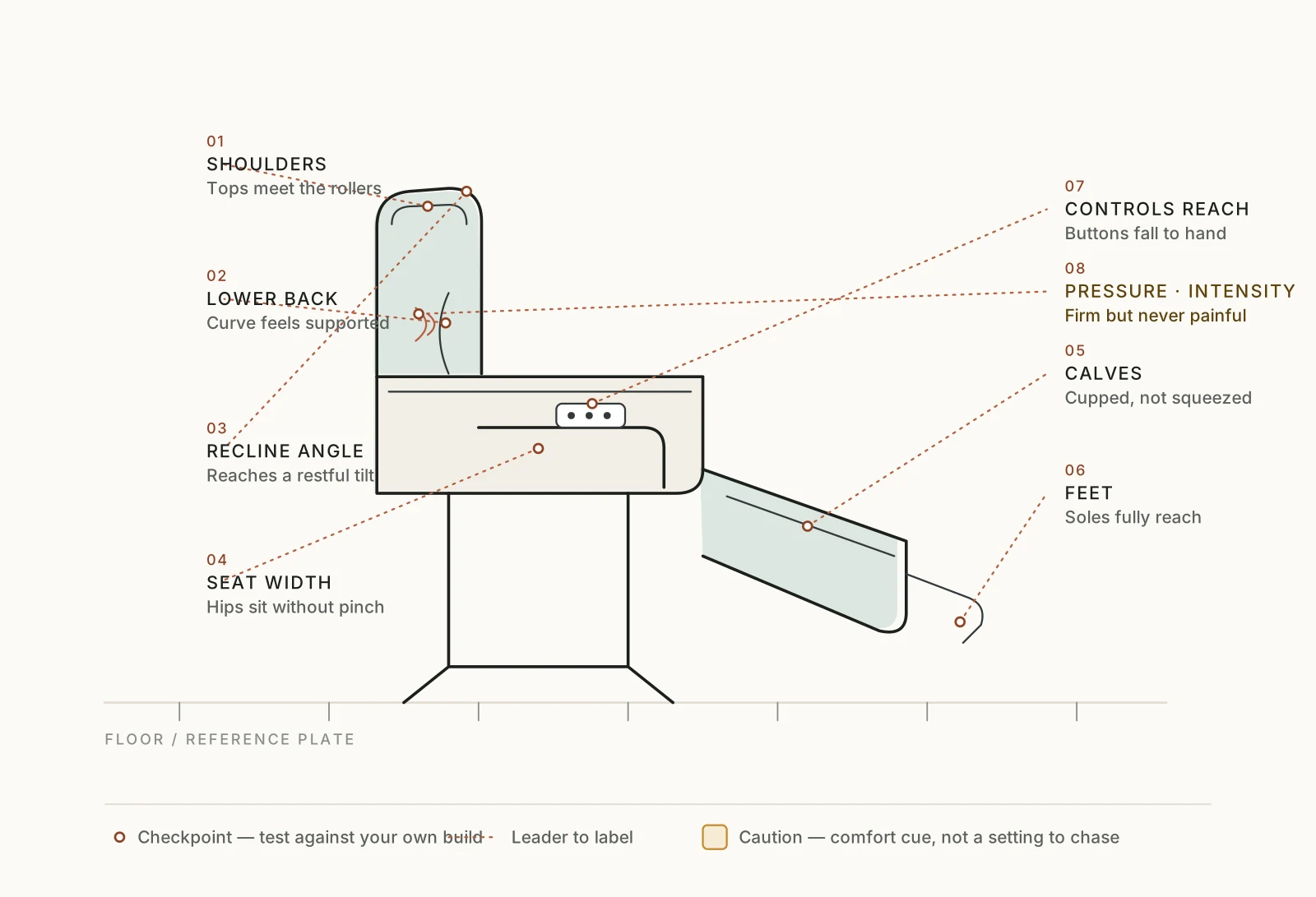
- Run the body scan, then pause. The top rollers should sit at or just above your shoulders.
- Choose a rolling program. Feel where the rollers start and stop, including under the seat.
- Set depth to its lowest, then its highest. Both ends should feel usable.
- On a 4D chair, run a program that changes speed. The rhythm should feel natural.
- Recline to zero gravity and repeat the coverage check. Contact points shift as you recline.
Print the test-sit checklist before your visit.
Which track and roller setup fits you?
- Taller buyers: look for track length and footrest extension that cover your back and legs.
- Shorter buyers: check that the top rollers reach your shoulders and your feet reach the foot rollers.
- Pressure-sensitive buyers: favor adjustable 3D depth with a gentle lowest setting.
A note on claims
Track and roller labels describe hardware and movement. They are not evidence of a health outcome, and a longer track or a higher roller dimension does not make a chair a medical device. A massage chair is a comfort and relaxation product; if you have a diagnosed condition, talk with a qualified healthcare professional first. See how to read massage chair claims.
Frequently asked questions
What is an SL track massage chair?
SL track chairs combine an S-shaped curve along the back with an L-shaped extension under the seat. Compare the stated track length, the user height range and where the rollers stop when you sit.
Is a 4D massage chair better than a 3D massage chair?
A 4D chair is not automatically better: 3D usually means adjustable roller depth, and 4D adds speed or rhythm control. The labels are not standardized. Judge the gentlest and firmest settings, and notice whether the rhythm feels natural to you.
Before you buy
Read the specs, then trust the sit
Build a shortlist from the labels, then confirm coverage and depth in the exact model.
Last updated: October 2026 · Editorial standards · Disclosure